
Solo Travel on $30 a Day: Is It Actually Possible?
The Reality Behind Budget Travel That No One Tells You
Solo travel on $30 a day sounds either impossible or like a social media myth. Some people claim they do it everywhere. Others say it’s only possible if you “don’t enjoy life while traveling.”
The truth sits somewhere in between—and it has nothing to do with being cheap.
It has everything to do with where you go, how you plan, and how intentional you are with every decision.
Because $30 a day in Milan is not the same as $30 a day in Morocco. And even within the same country, your experience can change completely depending on timing, location, and how you move through the city.
This is not a theory. It’s based on real trips, real mistakes, and real breakdowns of what actually happens on the ground.
The Reality Behind “$30 a Day Travel”
The biggest misunderstanding about budget travel is thinking it’s a fixed rule.
It’s not.
A $30/day target is only a reference point. In reality, your costs shift based on:
- City and country
- Season and events
- Accommodation location
- Transportation choices
- Food habits and flexibility
In places like Paris or Milan, $30 can disappear in a single museum ticket or a night in a hostel during peak demand.
But in parts of Asia, North Africa, or Turkey, that same amount can cover accommodation, food, transport, and activities.
Budget travel is not about restriction—it’s about adaptation.
Where $30/Day Works—and Where It Doesn’t
When it becomes difficult fast
Major cities like Paris, Milan, Rome, Tokyo, or Dubai can push your budget instantly over $30/day if you follow typical tourist behavior.
Even a basic hotel night or a single tourist activity can break the limit.
When it becomes realistic
In places like Istanbul, parts of Southeast Asia, or North African countries such as Morocco, Algeria, and Tunisia, $30/day can be realistic with smart planning.
Currency conversion and local pricing structures work in your favor.
The hidden factor most people ignore
Flights, timing, and internal transport matter more than daily spending.
A cheap destination can become expensive if you arrive during festivals, weekends, or peak tourist seasons.
Real Case Study: 3 Days in Milan on a Tight Budget

Milan is one of the best examples of controlled budget travel when done correctly.
Accommodation strategy
A shared hostel booked two weeks in advance cost around $20 per night total, or roughly $10 per person.
Early booking made the difference.
Food discovery through locals
Instead of tourist restaurants, the best pizza spot was found by asking a delivery rider on the street.
Result: €6 pizza that was better than anything in tourist areas.
Transport system
A multi-ticket metro booklet was used, reducing transport costs significantly. Some unused tickets were even left behind after the trip.
Activities with discounts
At the Da Vinci museum, a simple interactive challenge (building a bridge and sharing it online) unlocked a 30% discount.
Final outcome
Total spending stayed between $20–$25 per day.
Real Case Study: Paris Under Pressure (When Budget Planning Fails)

Paris was a completely different experience—because of unexpected constraints.
The problem: payment failure
A broken bank card forced reliance on cash withdrawals and limited flexibility.
Hidden hotel costs
City taxes were not included in booking platforms and added unexpected daily costs.
Transport inefficiency
Multiple ATM trips and metro rides were required just to resolve payment issues.
Lesson learned
Even with a strict budget mindset, poor preparation can break your entire system.
The Hidden Mistakes That Break a Travel Budget
Most budget failures don’t come from spending too much—they come from planning wrong.
Common mistakes include:
- Booking flights, hotels, and transport separately without strategy
- Trusting tourist packages without comparing local options
- Paying inflated tourist prices instead of local pricing
- Ignoring hidden fees like taxes or cash-only requirements
These mistakes often cost 30–40% more than necessary spending.
How to Actually Stay Under Budget (Without Overthinking It)
There is no perfect formula, but there are consistent behaviors that work.
Plan destinations together
Flights, cities, and accommodation should be treated as one system—not separate decisions.
Stay central
Being close to the city reduces transport costs and increases access to food and activities.
Use local knowledge
Delivery drivers, locals, and residents often know the cheapest and best places—not travel blogs.
Stack discounts
Apps often offer first-user discounts or promotions. Using multiple platforms can reduce costs significantly.
Be flexible
Short stays use day passes. Longer stays use weekly or bundled transport cards.
What $30/Day Travel Feels Like in Real Life

Budget travel is not just financial—it changes how you experience a city.
Slower travel pace
You focus less on checking boxes and more on actually observing the city.
Moderate comfort level
Hostels, shared rooms, and simple sleeping setups become normal.
Food experience
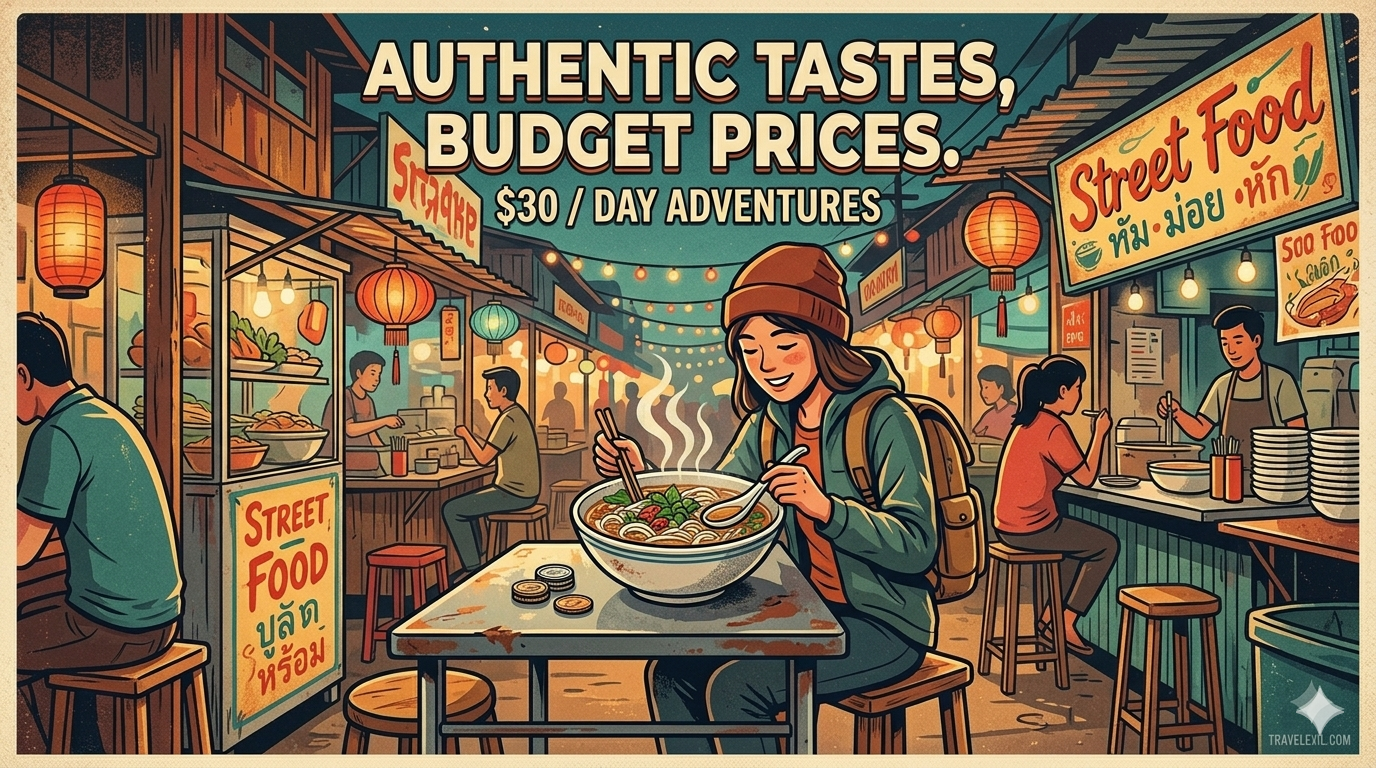
Street food and local spots replace expensive restaurants—but often deliver better experiences.
Social interactions
You meet more travelers and locals, often in more meaningful ways.
Overall feeling
Less rushed, more present, and more observational.
When the Budget Breaks (And Why It Happens)
Even with planning, budget systems fail in predictable situations:
- Festivals and peak tourist seasons
- Cities dominated by tourism instead of local life
- Hidden fees or cash-only systems
- Poor route planning between destinations
These are not small issues—they can double your expected costs.
The Core Philosophy of Budget Solo Travel
The biggest misconception about $30/day travel is that it’s about restriction.
It’s not.
It’s about intentionality.
You don’t need to do every activity in a city. Don’t need to follow tourist checklists. Neither need to maximize spending to maximize experience.
Instead:
- Choose experiences that match your personality
- Avoid overcrowded tourist traps
- Prioritize quality over quantity
- Adjust expectations based on reality, not online claims
Sometimes $30 is enough. Sometimes it isn’t. The goal is not to force it—it’s to understand it.
Final Verdict: Is $30/Day Travel Possible?
Yes—but not universally.
It depends on:
- Destination
- Timing
- Planning quality
- Personal flexibility
But the real takeaway is this:
Budget travel is not about surviving on less money. It’s about making smarter decisions so your money creates better experiences.
And when done correctly, $30/day stops being a limitation—and becomes a strategy.