Seven of us needed visas for the trip. One already had a valid visa, so we thought everything was fine. I handled most of the planning myself. Flights, documents, hotels, timing, everything.
Then airport staff stopped us.
One passport had less than three months before expiration. The visa was valid. The passport was not.
I missed it.
We spent almost two hours moving between airport staff, security, and counters trying to solve the issue before boarding closed. Luckily, we arrived four hours early. If we came late like most travelers do, that trip would probably have ended inside the airport.
That moment taught me something important.
Travel is not only about booking flights and hotels. Travel is about catching the small details before they become expensive problems.
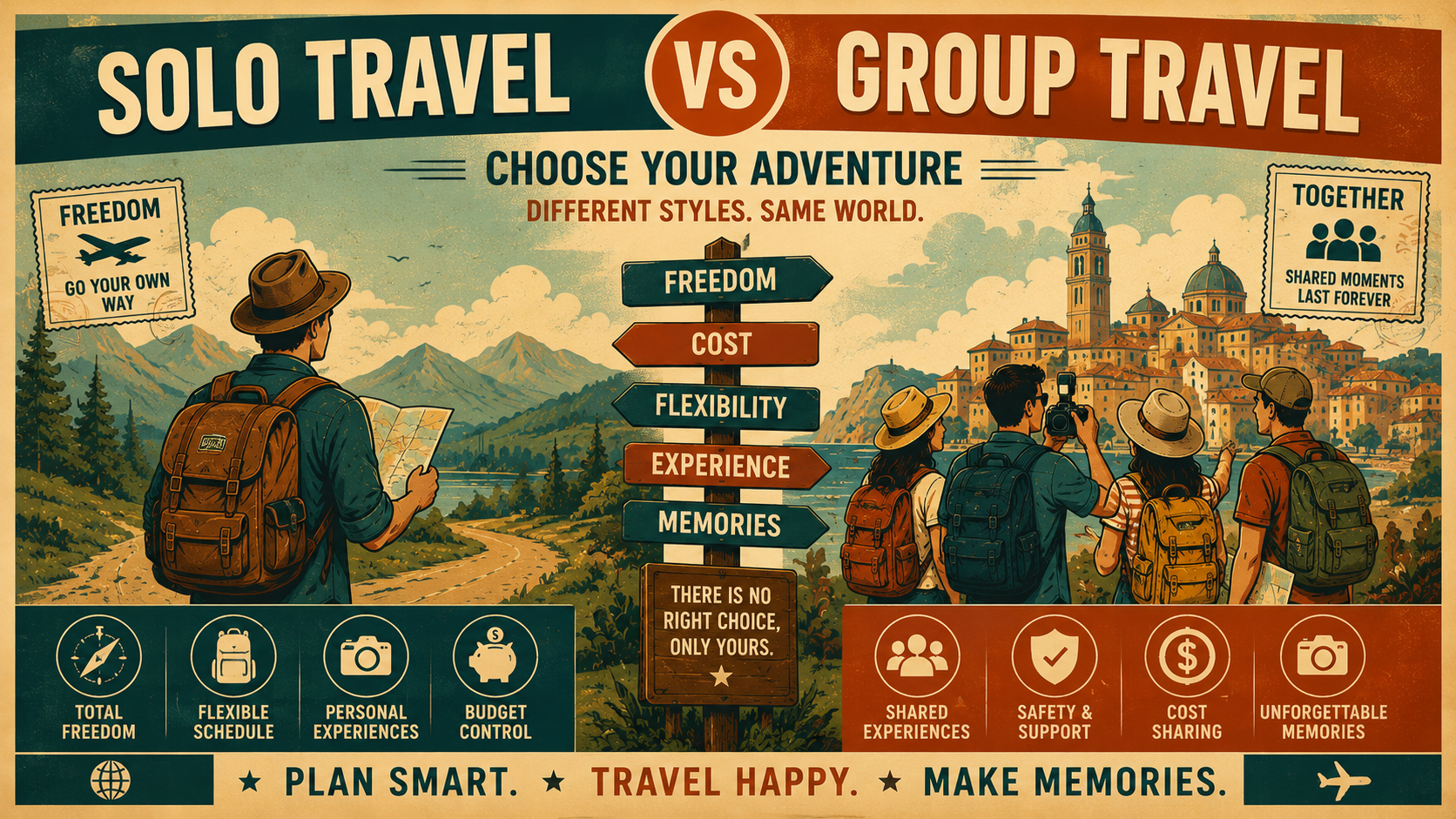
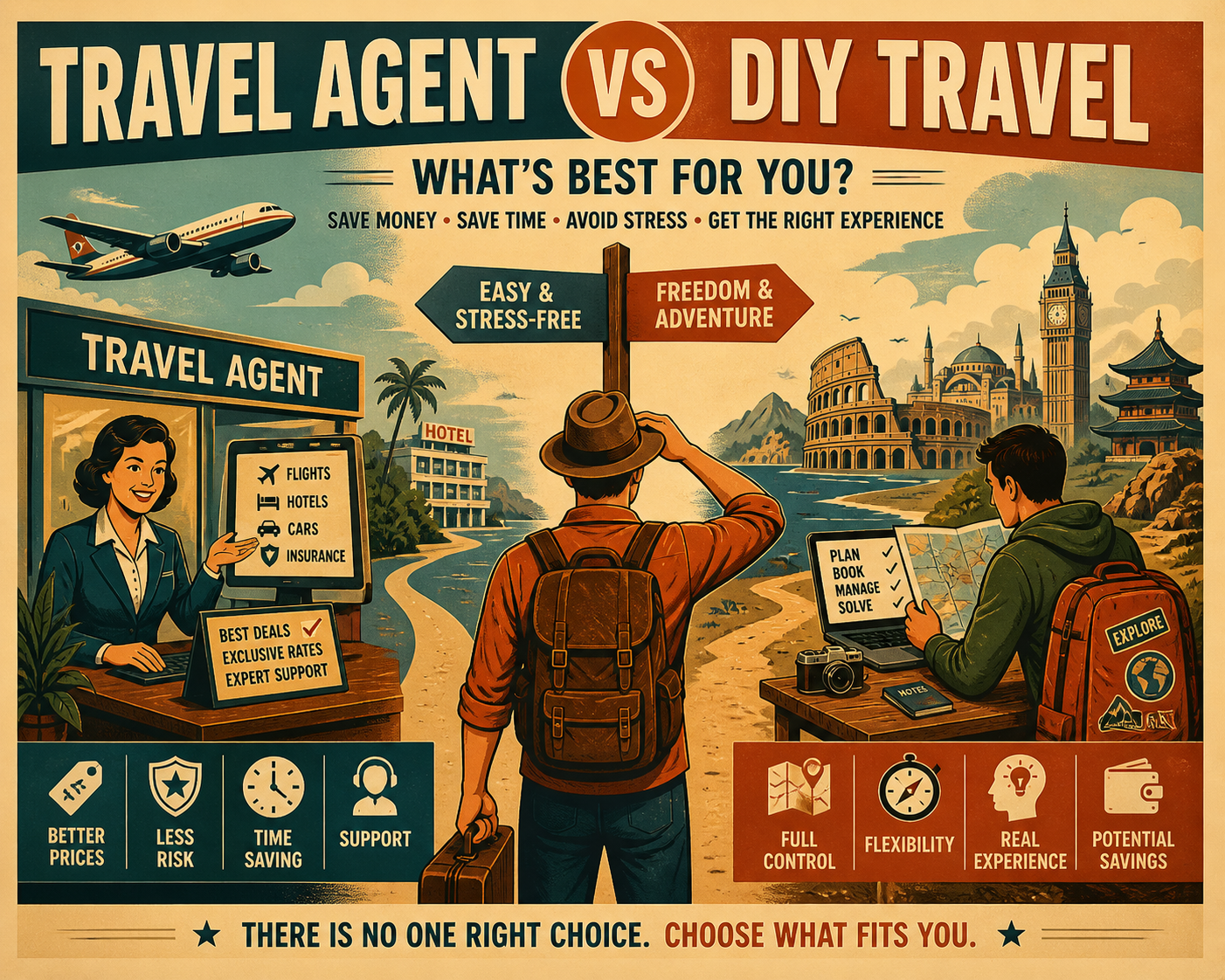
And that is exactly where the difference between DIY travel and travel agents starts.
But after years of traveling, planning trips for groups, handling visas, dealing with hotels, airports, delays, and even bad travel agents themselves, I learned something else too:
Travel agents are not always better.
Sometimes you are actually safer handling things yourself.
I’ve Done Both
I’m not writing this as someone who only uses agencies or only travels alone.
I’ve planned trips for myself, for friends, for family members, and for groups. Local travel. International travel. Budget travel. Group travel across countries, languages, currencies, and time zones.
I also worked closely with travel agents before. In some situations, I basically acted like one myself.
So I understand both sides very well.
And honestly, most articles about this topic oversimplify everything.
They make it sound like travel agents magically solve every problem.
That is not how real travel works.
What DIY Travelers Usually Miss
One of the first mistakes I made happened in Italy.
At the time, I was traveling on a tight budget with a friend. We booked a cheap hotel room. I remember the price clearly because we planned everything carefully. Around $15 to $20 per night.
Perfect for us.
Then we arrived and paid almost $30.
Taxes.
Fees.
Extra charges that were either hidden, unclear, or simply ignored while booking.
When you are new to travel, you focus on the visible price. Experienced travelers know the visible price is rarely the final price.
That is something good travel agents usually catch immediately because they already know the local system.
Another thing DIY travelers miss is time itself.
And I don’t mean scheduling.
I mean time zones.
You see a flight leaving at 10 a.m. and arriving at 10 a.m. You think the trip takes no time. Then you realize the countries use different time zones, different local references, and suddenly your hotel check-in, train ticket, or next flight no longer makes sense.
People underestimate how mentally exhausting travel becomes when multiple countries are involved.
Especially during group travel.
What Travel Agents Actually Do Better
The biggest advantage good travel agents have is access.
Not intelligence.
Not magic.
Access.
I saw this during a summer family trip.
Even with premium booking accounts and travel platform discounts, the travel agent still found hotel prices around 20 to 30 percent cheaper than what we could get ourselves.
Why?
Because agencies reserve rooms in bulk long before summer starts. Hotels give them rates normal travelers cannot access individually.
That changes everything during high season.
Another thing agencies do well is combining services together.
Hotel.
Flight.
Car rental.
Insurance.
Ferry tickets.
Transfers.
Once everything becomes one package, pricing improves and coordination becomes easier.
And if you are traveling with kids, elderly family members, or someone with health issues, that support matters a lot more.
Because when you travel alone, every problem becomes your problem.
But Here’s the Part Nobody Talks About
Travel agents are not standing next to you when things go wrong.
A family I know drove almost 12 hours during summer heat to reach their hotel destination. Customs, checkpoints, traffic, exhaustion, everything.
They finally arrived at the hotel around check-in time.
The room was not ready.
They waited two or three more hours.
Then they finally got access to the room and discovered something worse: the room had a connected door leading directly into another occupied room.
Imagine arriving exhausted after a 12-hour drive with your family and finding that.
They contacted their travel agency back home.
The agency answered.
But they could not actually solve anything.
The family still had to go downstairs themselves, argue with hotel staff themselves, wait again themselves, and finally change rooms themselves late at night.
That experience changed how I think about agencies.
Because agencies help before travel much more than during travel.
And that difference matters.
Sometimes Doing It Yourself Is Better
One of my most useful travel experiences happened after something went wrong.
I was traveling with a friend from France to Germany and then to another country. We traveled light, almost no luggage, because moving fast between countries becomes easier that way.
We boarded the plane.
Then suddenly everything stopped.
A child inside the aircraft got injured after hitting the seat badly enough to fracture an arm. Emergency teams entered the plane and extracted the child while everyone waited.
The delay lasted around two hours.
By the time we landed, we lost our hotel booking.
At that moment, we had two choices.
Panic.
Or solve it.
We booked another hotel ourselves immediately. The next morning, we submitted a compensation request directly through the airline website.
Ten minutes.
That’s all it took.
A few days later, we received compensation, refunds, and bonus travel points.
No agency involved.
No waiting.
No middleman.
Just direct action.
That experience taught me something important too:
Experienced travelers often solve problems faster themselves because they already understand how travel systems work.
The Worst Experience I Had Was Actually With an Agent
One time, we decided to use an agency for visa handling during a group trip.
Doing everything ourselves would have cost more money upfront, so the agency looked like the smarter option financially.
Big mistake.
The process became slow. Extremely slow.
Instead of finishing visa procedures within weeks, everything dragged for more than a month. Communication became unclear. Promises kept changing.
Eventually we realized we had been scammed for part of the money.
The situation became serious enough that legal action got involved.
That experience completely changed how I evaluate travel agents now.
Good reviews are not enough.
Popularity is not enough.
An agency might be good for one destination and terrible for another.
If they have no real experience handling your specific type of trip, you become their experiment.
And you never want your international travel to become someone’s learning experience.
So, Should You Use a Travel Agent?
Honestly, it depends more on your personality than your budget.
If you hate stress, hate planning, and want someone else to organize everything for you, a good travel agent helps a lot.
If you travel with children, elderly family members, or complicated schedules, agencies reduce pressure and save time.
But if you enjoy flexibility, solving problems, adapting during travel, and learning from experience, doing things yourself becomes part of the adventure.
That is how I personally see travel now.
The mistakes.
The airport stress.
The delayed flights.
The hidden hotel fees.
The visa problems.
The wrong bookings.
Those moments become stories later.
And sometimes those stories teach you more than a perfect trip ever could.
So when people ask me, “What can a travel agent do that I can’t do myself?”
My answer is simple.
A good travel agent can save you time, reduce stress, and unlock better pricing.
The Reality Behind Budget Travel That No One Tells You
Solo travel on $30 a day sounds either impossible or like a social media myth. Some people claim they do it everywhere. Others say it’s only possible if you “don’t enjoy life while traveling.”
The truth sits somewhere in between—and it has nothing to do with being cheap.
It has everything to do with where you go, how you plan, and how intentional you are with every decision.
Because $30 a day in Milan is not the same as $30 a day in Morocco. And even within the same country, your experience can change completely depending on timing, location, and how you move through the city.
This is not a theory. It’s based on real trips, real mistakes, and real breakdowns of what actually happens on the ground.
The Reality Behind “$30 a Day Travel”
The biggest misunderstanding about budget travel is thinking it’s a fixed rule.
It’s not.
A $30/day target is only a reference point. In reality, your costs shift based on:
City and country
Season and events
Accommodation location
Transportation choices
Food habits and flexibility
In places like Paris or Milan, $30 can disappear in a single museum ticket or a night in a hostel during peak demand.
But in parts of Asia, North Africa, or Turkey, that same amount can cover accommodation, food, transport, and activities.
Budget travel is not about restriction—it’s about adaptation.
Where $30/Day Works—and Where It Doesn’t
When it becomes difficult fast
Major cities like Paris, Milan, Rome, Tokyo, or Dubai can push your budget instantly over $30/day if you follow typical tourist behavior.
Even a basic hotel night or a single tourist activity can break the limit.
When it becomes realistic
In places like Istanbul, parts of Southeast Asia, or North African countries such as Morocco, Algeria, and Tunisia, $30/day can be realistic with smart planning.
Currency conversion and local pricing structures work in your favor.
The hidden factor most people ignore
Flights, timing, and internal transport matter more than daily spending.
A cheap destination can become expensive if you arrive during festivals, weekends, or peak tourist seasons.
Real Case Study: 3 Days in Milan on a Tight Budget
Milan is one of the best examples of controlled budget travel when done correctly.
Accommodation strategy
A shared hostel booked two weeks in advance cost around $20 per night total, or roughly $10 per person.
Early booking made the difference.
Food discovery through locals
Instead of tourist restaurants, the best pizza spot was found by asking a delivery rider on the street.
Result: €6 pizza that was better than anything in tourist areas.
Transport system
A multi-ticket metro booklet was used, reducing transport costs significantly. Some unused tickets were even left behind after the trip.
Activities with discounts
At the Da Vinci museum, a simple interactive challenge (building a bridge and sharing it online) unlocked a 30% discount.
Final outcome
Total spending stayed between $20–$25 per day.
Real Case Study: Paris Under Pressure (When Budget Planning Fails)
Paris was a completely different experience—because of unexpected constraints.
The problem: payment failure
A broken bank card forced reliance on cash withdrawals and limited flexibility.
Hidden hotel costs
City taxes were not included in booking platforms and added unexpected daily costs.
Transport inefficiency
Multiple ATM trips and metro rides were required just to resolve payment issues.
Lesson learned
Even with a strict budget mindset, poor preparation can break your entire system.
The Hidden Mistakes That Break a Travel Budget
Most budget failures don’t come from spending too much—they come from planning wrong.
Common mistakes include:
Booking flights, hotels, and transport separately without strategy
Trusting tourist packages without comparing local options
Paying inflated tourist prices instead of local pricing
Ignoring hidden fees like taxes or cash-only requirements
These mistakes often cost 30–40% more than necessary spending.
How to Actually Stay Under Budget (Without Overthinking It)
There is no perfect formula, but there are consistent behaviors that work.
Plan destinations together
Flights, cities, and accommodation should be treated as one system—not separate decisions.
Stay central
Being close to the city reduces transport costs and increases access to food and activities.
Use local knowledge
Delivery drivers, locals, and residents often know the cheapest and best places—not travel blogs.
Stack discounts
Apps often offer first-user discounts or promotions. Using multiple platforms can reduce costs significantly.
Be flexible
Short stays use day passes. Longer stays use weekly or bundled transport cards.
What $30/Day Travel Feels Like in Real Life
Budget travel is not just financial—it changes how you experience a city.
Slower travel pace
You focus less on checking boxes and more on actually observing the city.
Moderate comfort level
Hostels, shared rooms, and simple sleeping setups become normal.
Food experience
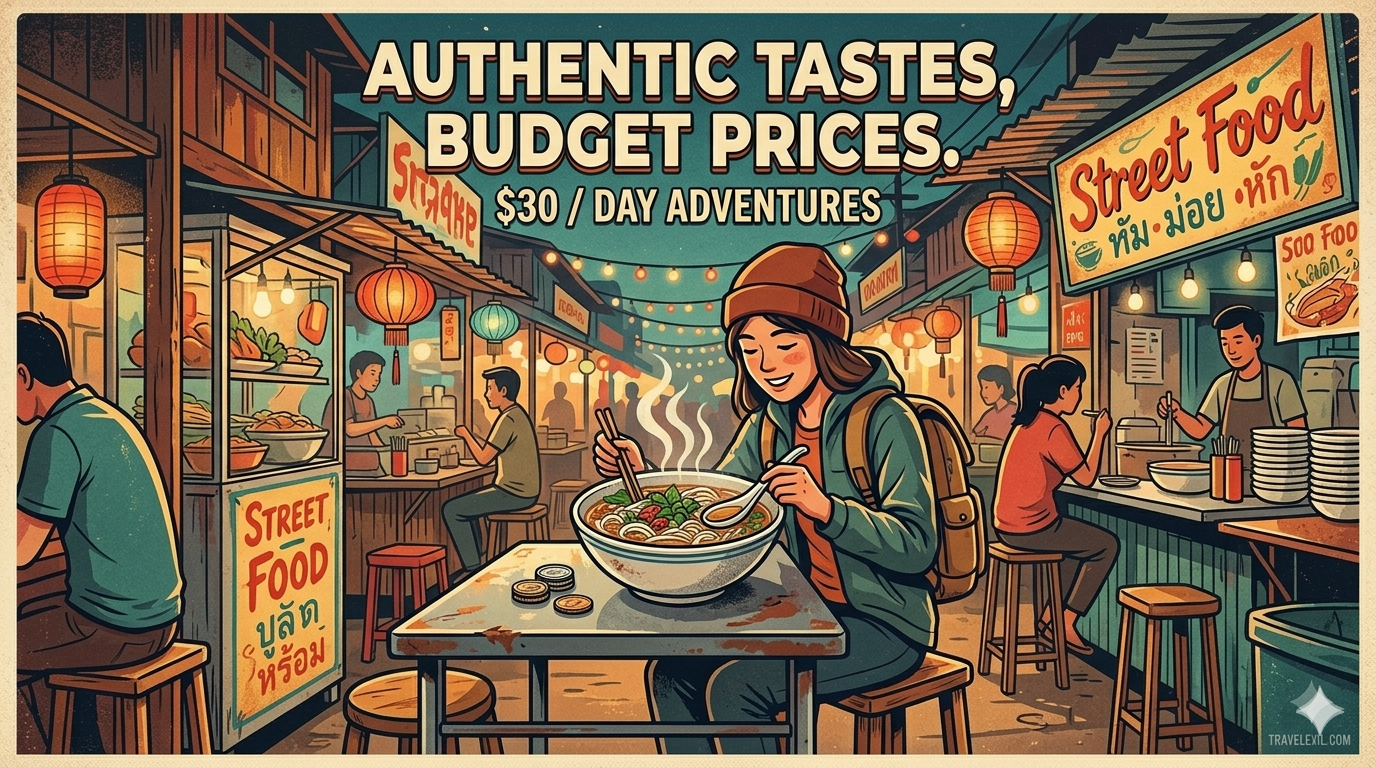
Street food and local spots replace expensive restaurants—but often deliver better experiences.
Social interactions
You meet more travelers and locals, often in more meaningful ways.
Overall feeling
Less rushed, more present, and more observational.
When the Budget Breaks (And Why It Happens)
Even with planning, budget systems fail in predictable situations:
Festivals and peak tourist seasons
Cities dominated by tourism instead of local life
Hidden fees or cash-only systems
Poor route planning between destinations
These are not small issues—they can double your expected costs.
The Core Philosophy of Budget Solo Travel
The biggest misconception about $30/day travel is that it’s about restriction.
It’s not.
It’s about intentionality.
You don’t need to do every activity in a city. Don’t need to follow tourist checklists. Neither need to maximize spending to maximize experience.
Instead:
Choose experiences that match your personality
Avoid overcrowded tourist traps
Prioritize quality over quantity
Adjust expectations based on reality, not online claims
Sometimes $30 is enough. Sometimes it isn’t. The goal is not to force it—it’s to understand it.
Final Verdict: Is $30/Day Travel Possible?
Yes—but not universally.
It depends on:
Destination
Timing
Planning quality
Personal flexibility
But the real takeaway is this:
Budget travel is not about surviving on less money. It’s about making smarter decisions so your money creates better experiences.
And when done correctly, $30/day stops being a limitation—and becomes a strategy.
1. Introduction: The Real Question Behind Travel Agents
Travel looks simple now. You open a few apps, compare prices, and book everything in minutes. Flights, hotels, and even visas feel accessible.
But the real question is not whether you can book everything yourself. You can.
The real question is whether you should.
You only understand the difference after you deal with real travel problems. I planned trips for myself, friends, and family. I also worked with travel agents and handled group travel where everything had to work across countries, time zones, and budgets.
This is what actually matters when you compare both approaches.
2. My Background in Travel Planning
I plan travel in different ways.
I plan my own trips, planning trips for friends and family. Also handling local travel, regional travel, and international travel. I also manage group trips where timing, documents, and coordination become critical.
I also worked with travel agents and observed how they operate. In some cases, I acted like one myself, handling bookings, visas, and logistics for multiple people.
So I know both sides.
DIY travel. And agency travel.
3. What Goes Wrong When You Plan Everything Yourself
Hidden costs change your budget
You book a hotel at a low price. You think you are staying within budget. Then you arrive and pay more.
In Italy, I booked a hotel for around $15 to $20 per night. The final price became $30. The difference came from taxes and fees that were not clear at the time of booking.
You do not always see the full cost upfront when you book alone.
Small mistakes create big problems
Group travel increases risk.
In one trip with friends, I handled visas for most of the group. One person already had a visa, but their passport validity was too short for entry rules. It had two months left, but the requirement was at least three months.
We reached the airport with everything ready, but this detail almost stopped boarding. Then spent hours talking with airport staff. So we only got through because we arrived early and pushed the process forward.
One missed check creates hours of stress.
Time zones create confusion
Flight schedules look simple until you deal with different countries.
You see departure and arrival times that look identical on paper, but they are not. The time reference changes depending on where the ticket originates.
If you do not double-check, you risk missing flights or misreading your itinerary.
4. Where Travel Agents Add Real Value
Better pricing access
Travel agents often access prices you do not see on public platforms.
In one family trip, hotel prices dropped by 20 to 30 percent when booked through an agent compared to direct booking platforms, even with loyalty discounts.
Agents work with bulk bookings and long-term agreements. You do not.
Bundled travel savings
Agents combine flights, hotels, and transport into packages.
This creates better pricing and simpler coordination. You avoid managing multiple systems and separate bookings.
You also get access to deals that depend on volume, not individual bookings.
Support for higher-risk travelers
Families with children, elderly travelers, or complex itineraries benefit most.
Agents handle insurance, documentation, and coordination. They reduce exposure to common travel risks.
You do not need to manage every detail yourself.
5. Where DIY Travel Works Better
Move faster
You do not wait for approvals or back-and-forth communication. You choose, book, and adjust instantly.
Learn the system
DIY travel builds experience.
You learn how visas work, understand airline rules. Then check how hotels structure pricing and improve every trip you take.
Handling real problems directly
On a flight from Germany, an accident caused a two-hour delay. We missed our hotel booking at the destination.
So we handled everything ourselves. We filed compensation directly with the airline. It took minutes to submit and days to receive a refund.
No agent was needed.
Direct action worked better.
6. When Travel Agents Fail You
Agents are not physically present when problems happen.
In one case, a family arrived after a long journey and waited hours to check in, even though the booking was confirmed. The hotel was overbooked.
Later, they received a room that was not suitable, with shared access issues. They had to go back to reception and fix the problem themselves.
The agent responded but could not solve it on the spot.
Distance limits action.
7. Not All Travel Agents Work the Same
Travel agents vary a lot.
Some are large companies with strong systems. Some are solo operators with limited experience.
Experience matters more than reputation alone.
I also had a case where an agent turned out to be unreliable. The process broke down, and we had to go through legal steps to recover money.
Even feedback from others does not guarantee your outcome.
You still need to check their real capability for your specific trip.
8. Clear Decision Framework
Use a travel agent when:
You do not have time to manage travel
You want a stress-free process
You travel with family, children, or elderly people
You prefer convenience over control
Do it yourself when:
You want full control over your trip
You enjoy planning and research
You want to learn from experience
You are flexible and can solve problems on the move
9. The Core Truth
Travel depends on how you think.
Some people want structure. They want someone to handle everything. A travel agent fits that need.
Some people want control. They want experience and flexibility. DIY travel fits that need.
There is no universal answer.
There is only what fits your situation.
10. Conclusion
Travel agents and DIY planning both work.
But they solve different problems.
Use an agent when you want convenience and reduced stress.
Plan yourself when you want control and experience.
Most important point: choose based on how you travel, not what looks cheaper or easier on paper.
Umrah is a pilgrimage to Makkah, distinct from the annual Hajj but no less spiritually rewarding. Often referred to as the “lesser pilgrimage,” it involves a series of rituals that bring Muslims closer to Allah and offer an opportunity for spiritual renewal.
Photo by Neo Evenger: https://www.pexels.com/photo/kaaba-28209449/
Why Perform Umrah from the US?
Living in the US can feel distant from the holy sites, but that makes the experience even more special. The journey serves as both a spiritual and physical adventure, offering moments of reflection and immense gratitude.
Planning Your Umrah Journey
When Is the Best Time to Go?
While Umrah can be performed any time of the year, many prefer cooler months like December to February. Avoid peak seasons, such as Ramadan, if you’re looking for a less crowded experience.
Umrah vs. Hajj: What’s the Difference?
Unlike Hajj, which is mandatory and time-specific, Umrah is voluntary and can be performed anytime. Think of it as a spiritual getaway, whereas Hajj is a once-in-a-lifetime obligation for Muslims who can afford it.
Preparing for Umrah
Getting Your Documentation Ready
Passport and Visa Requirements Ensure your passport is valid for at least six months beyond your travel date. You’ll need a Saudi visa, which can be obtained through official channels or travel agencies.
Vaccination Certificates Saudi Arabia requires proof of certain vaccinations, such as meningitis and COVID-19. Check current health regulations well before your trip.
Budgeting for Your Trip
From flights and accommodation to meals and transportation, an average Umrah trip from the US can range between $2,000 and $5,000 per person. Planning ahead helps avoid unexpected expenses.
Booking Flights and Accommodation
Book flights at least 2-3 months in advance for better deals. Popular airlines include Emirates, Turkish Airlines, and Saudia. For accommodations, look for hotels close to the Haram to minimize walking distances.
Packing Essentials
Clothing for Ihram
Ihram is the special attire pilgrims wear. For men, it’s two white unstitched sheets, and for women, any modest, loose-fitting clothing that adheres to Islamic guidelines.
Travel Gadgets and Accessories
Pack essentials like a power bank, universal adapter, and small travel-sized toiletries. Don’t forget comfortable shoes for walking around the Haram.
Spiritual Preparation
Strengthening Your Intention (Niyyah)
Umrah is not just a physical journey but a spiritual one. Spend time purifying your intentions and seeking forgiveness before embarking on this sacred trip.
Understanding the Rituals of Umrah
Learn about each ritual in advance to avoid confusion. Watching videos or attending local Islamic seminars can be immensely helpful.
Performing Umrah
Arriving in Makkah: What to Expect
The moment you see the Kaaba for the first time is unforgettable. Prepare yourself emotionally for this awe-inspiring experience.
Step-by-Step Guide to Umrah
Entering the State of Ihram Declare your intention for Umrah at the designated Miqat station and recite the Talbiyah: “Labbaik Allahumma Labbaik…”
Tawaf (Circling the Kaaba) Walk around the Kaaba seven times counterclockwise, starting from the Black Stone.
Sa’i (Walking Between Safa and Marwah) Retrace Hajar’s steps between these two hills, symbolizing her search for water.
Halq or Taqsir (Shaving or Trimming Hair) For men, shaving the head is recommended, while women cut a small portion of their hair.
Cultural and Practical Tips
Navigating Saudi Arabia as an American
Language might be a barrier, but most people in Makkah and Madinah understand basic English. Learn a few Arabic phrases to make your experience smoother.
Dealing with Jet Lag and Adjusting to the Time Zone
Traveling across time zones can be tiring. Stay hydrated, and try adjusting your sleep schedule a few days before departure.
Additional Considerations
Traveling with Family or Elders
If you’re traveling with children or elderly family members, consider wheelchair rentals and family-friendly accommodations. Patience is key!
Combining Umrah with Ziyarah (Visiting Historical Sites)
Don’t miss historical landmarks in Makkah and Madinah, like Jabal al-Nour or the Prophet’s Mosque. These visits enhance your spiritual journey.
Conclusion
Performing Umrah from the US is a transformative experience that combines faith, travel, and personal growth. With careful planning and sincere intentions, your journey can be both smooth and spiritually uplifting.
FAQs
1. How long does an Umrah trip from the US usually last?
Most trips range between 7 to 10 days, including travel time. This allows enough time to perform Umrah and explore Makkah and Madinah.
2. Do I need a specific vaccination card for Umrah?
Yes, you’ll need proof of vaccinations like meningitis and COVID-19. Check Saudi Arabia’s latest health guidelines.
3. Can I perform Umrah during Ramadan?
Absolutely! It’s a rewarding time to perform Umrah, but expect larger crowds and higher expenses.
4. Is there a dress code for women during Umrah?
Women should wear modest, loose-fitting clothing and ensure their hair is covered. There’s no specific color requirement, but white or light-colored clothing is common.
5. Can I combine Umrah with a visit to other cities in Saudi Arabia?
Yes! Many pilgrims visit Jeddah or Riyadh after their Umrah. Just ensure your visa allows multiple entries if needed.
If you say that you are planning a backpacking Dubai trip, not many would take you seriously. For one, Dubai is one of the most luxurious and the most expensive cities in the world. Surviving on a backpackers’ budget in Dubai may seem to be impossible.
However, it is not so. There are ways in which you can enjoy a short holiday or daycation in Dubai without spending too much money.
While a short holiday would involve a long weekend, a daycation is when you visit the city for a day and do not spend the night here. The latter can happen if you live in one of the nearby Emirates or when you are in Dubai as a stopover during your international trip.
Whatever might be the case, it is possible to have a backpacking Dubai trip if you know where to stay and what to do without ruining your holiday budget.
What to See and Do While
Backpacking Dubai
One of the major questions that backpackers have is what can they see and do in Dubai without going overboard on their budget. Dubai is home to world-class attractions, and most require you to buy an entry ticket.
However, there are some things that you can do for free or without paying too much money in Dubai.
Abra Ride on Dubai Creek
The Dubai Creek is historically important. Not only does it divide the city into Bur Dubai and Deira but is also the first place that the Arabs settled when they moved from the desert to the city.
Although it was a modest fishing village not long ago, both sides of the Dubai Creek have developed considerably. One of the best ways to enjoy the sights around the Dubai Creek is to go on an abra ride.
The best thing about the abra ride on Dubai Creek is that it costs only AED 1 per person.
Al Fahidi Neighborhood
The gorgeous skyline of Dubai is the first thing that comes to mind when we think of the city. However, right within the city is the Al Fahidi Neighborhood, which would take you back in time when Dubai was a simple village that thrived on fishing and pearl diving.
Walking around the Al Fahidi Neighborhood is free. The narrow winding alleyways, the traditional homes, the wind towers, etc. are some of the interesting things to see here.
The place also has many art galleries and museums, some of which you can visit for free.
Dubai Museum
The Dubai Museum is an important place to visit if you want to know about the history and culture of the UAE. The museum is located inside the oldest building in Dubai, i.e. the Al Fahidi Fort.
Here you would get to see everything from Bedouin-style tents and homes to the traditional attire of the Arabs. The exhibits of the museum display the occupations, markets, and lifestyle of the Emiratis.
At the end of the tour, you get to see an audio-visual that shows the story of the development of Dubai and its future plans.
Desert Safari
As a tourist in Dubai, there are certain experiences that you should not miss, even as a backpacker. One such thing is the desert safari.
Desert safari tours are available at different rates, and you can choose one as per your budget. The desert safari gives you the chance to indulge in adventurous activities at the desert, which include dune bashing, camel riding, sandboarding, and quad biking.
There are entertainment programs as well where you would get to see engaging performances of Tanoura and belly dancers. The desert safari usually ends with a BBQ dinner.
Kite Beach
Dubai is a coastal city that is home to several beautiful beaches. While several are private beaches owned by hotels, you would find many public beaches that you can visit for free.
Kite Beach is one of the most popular beaches here. If you are a sporty person, you can indulge in a variety of water sports like kite surfing, kayaking, paddle boarding, etc.
The best part about this beach is that you get a clear view of Burj Al Arab, the sail-shaped hotel. Also, do not miss the amazing sunset at the Kite Beach.
Dubai Mall
Dubai is filled with some amazing shopping malls, but Dubai Mall is surely the biggest and the best. While shopping at the 1200 retail stores that sell branded and luxury items may not be on the agenda of a backpacker, the Dubai Mall is worth the visit even if you do not want to shop.
You can take a look at the Dubai Aquarium and Underwater Zoo from outside. There is the VR Park Dubai, where you can enter without an entry fee and pay for only those rides you are interested in.
Dubai Mall also has some amazing sculptures and attractions. There is also the fountain show that happens right outside the mall every evening from 6 PM, which you should not miss.
BurjKhalifa
Right next to the Dubai Mall is the BurjKhalifa, which is the tallest building in the world. If you do not mind spending some money from your travel budget, visiting the observation deck on the 124th or 148th floor is worth it.
A tour of BurjKhalifa would get you the chance to see the museum that tells you the story of the building and also ride on the fastest elevator on earth.
Moreover, the observation deck gives you an aerial view of the entire city. On the other hand, taking a look at this grand structure from outside is also one of the best things to do in Dubai.
Jumeirah Mosque
Dubai is a modern metropolis but the culture of its people is still deep-rooted in Islam. Only few mosques in Dubai are open to non-Muslims, and Jumeirah Mosque is one of them. It is also one of the most photographed buildings in Dubai.
To know more about the architecture of the mosque and in general about Islam, it would be best to go for a guided tour that happens every morning, except on Fridays.
Remember to dress conservatively, i.e. wear dresses that cover your shoulders and knees. Traditional abaya and kandoura are available for free at the entrance.
Souks of Dubai
What’s travelling without taking a few souvenirs and mementos back home. If you want to indulge in shopping without overspending, the souks of Dubai are great place to go to.
Located in Old Dubai, the city has 4 main souks: the gold souk, the spice souk, the perfume souk, and the textile souk. Here, you can buy everything from exotic spices to gold jewelry.
Don’t forget that bargaining before buying anything is a norm here.
Where to Stay while
Backpacking Dubai
If you are planning a daycation in Dubai, you would not need to find accommodation here. In that case, you can skip this part. However, for people who are in Dubai on a budget, accommodation is one of the major concerns.
Dubai is home to some of the most luxurious hotels in the world, including the only seven-star hotel, the Burj Al Arab. However, it is important to know that Dubai is home to not only budget hotels but also hostels for backpackers. Here are some of the hostels where you can stay while backpacking in Dubai:
Backpacking Dubai At The Top
Known to be the best hotel in Dubai, At The Top is the only one located in the Dubai Marina district. What makes it the most favorite is that it is located on the 66th floor and provides you with an incredible view of the city.
At The Top hostel has 24×7 reception service, complimentary continental breakfast, and high-speed Wi-Fi too. Guests are free to use a fully-functional kitchenette to prepare their meals, snacks, and beverages. The place is spotlessly clean and also provides its guests with safety lockers as well as clean towels and lines.
Domme Hostel
If you want to stay at a hostel that is closer to all the popular attractions of the city, Domme is a good option. It is located near the city center, some 2.9 km from Dubai International Airport.
Apart from accessibility, Domme also has several facilities like 24-hour security, free breakfast, high speed internet, meeting rooms, etc. The place has a friendly staff, and it is a perfect hostel where you can meet and interact with fellow backpackers while playing board games or puzzles. One of the best things about Domme is that it is pet friendly.
Backpacking Dubai Hostel
If you are looking for the cheapest hostel, i.e. a place where you can keep your belongings and sleep during the day, the BackPacker Hostel is your best option. This hostel provides some basic facilities including complimentary breakfast, air conditioning, Wi-Fi, meeting rooms, etc.
Moreover, it is quite close to the main attractions of Dubai and also provides you with a comfortable bed to rest and relax after a tiring day exploring the city. Some other hostels in Dubai include Marina Dream, Royal Plaza Apartments, Dubai Beach Host, etc.
Moreover, if you want to enjoy a hostel experience with a private room, Saffron Boutique Hotel, Abidos Hotel Apartment Dubailand, Fortune Classic Hotel Apartments, etc. are some good options. Other than the hostels, AirBnB and couchsurfing are also good options for a backpacking Dubai trip.
Where to Eat while
backpacking Dubai
Dubai is a land where you would find some of the most expensive fine dining restaurants in the world. However, you can definitely eat in Dubai without breaking your budget. If you are staying at a hostel, you can use their kitchen and cook your own meal by getting the groceries from the supermarket.
Apart from this, there are several small restaurants and eateries where you can enjoy delicious meals without spending too much money. Bur Dubai, Karama, Deira, etc. are some of the places where you can enjoy food at inexpensive rates. Some of the cuisines that you can try here include Mediterranean, Chinese, Lebanese, Indian, etc.
How to Travel While
Backpacking Dubai
The best and the
cheapest ways to travel in Dubai is via metro. The Dubai metro is efficient and
connects the city well. You would also find local buses to most of the popular
attractions of the city. Apart from this, cabs in Dubai are also cheaper when
compared to other cities in the world.
Dubai may not be the
first choice when it comes to a backpacking holiday. However, there is no
reason that you cannot include this on your bucket list. A rich culture, a cosmopolitan
community, record-breaking landmarks, and fun times are what await you in the
Emirate city of Dubai.
Today we arrive on the island of Bali. Let’s go for 20 days in Kuta Beach! After the short visit in Mataram, we are finally rewarded. Let’s enjoy the beach, the sun, and the swimming pool once again!
Until a few decades ago, Kuta was a fishing village, but that has changed a lot… In the 60s, hippies were doing their road trips in Asia and their journeys often passed through Kuta.
Since then, the city has once again changed with the advent of mass tourism. There are luxury resorts, hotels, bars, restaurants, shopping centers and lots of entertainment. From this mixture was born the reputation of Kuta Beach.
Travelers’ reviews of Kuta Beach are very mixed. On the one hand, this is “the place to be” and on the other hand, it is the place to avoid. So how can you give you the right advice? In what follows, we list you point by point what we saw in Kuta so that you can form your own opinion.
Kuta Beach
Kuta Beach is a very popular beach in Bali. Its wide expanse of white sand for miles has made it one of the island’s premier tourist destinations. You can also see in the distance, south of Kuta, the city’s airport where planes land at a maddening pace.
Enough room to do it all
If you go for a walk on this beach, you will have something to take care of because it is so big. You can rent sunbeds and an umbrella for the day for a few rupees or just sunbathe on your towel and see the prowess of the surfers. The waterfront walks are very pleasant. It can go on for hours if you like to walk. Some mark the lines of an imaginary land in the sand for a match between friends, others will sip a cocktail to watch the sunset. You can also have a massage in the shade of the palm trees by a pretty Balinese girl. If you love to dance and are there at the right time, sometimes there are classes given on the beach. From 7 to 77 years old, everyone can participate and follow the rhythmic rhythm of the music, their feet in the soft sand.
Watch out for…. wave
Tip: swim between the red flags, because this is where the beach is supervised. Besides, the rescuers are very strict. At the slightest misstep, they will ask you to move in or out of the water for safety. The waves and the currents are very strong, several accidents and drownings of tourists happen every year. After a few meters in the water, it becomes really dangerous without a board. You are carried away without being able to do anything about it.
The meeting place for surfers
The big waves of Kuta Beach are the perfect place for professional surfers or beginners. You can either take lessons with a professional, or just rent a board and risk it on your own. For the less adventurous, there are also bodyboard boards that make their effect. No illusions though, they’ll whirl you around anyway!
It is true that for swimmers, it can be a bit disturbing. Too many waves, too many surfers … But we did it and we found it super fun! Yes, we assume, we played for hours like children Who never got into a wave before it broke? And if you stay at the water’s edge, you’ll be in a large paddling pool.
Yes, there are Tides in Kuta
Surfers take into account the coefficient of the tides, the high tide being more favorable to large waves. You can also take very beautiful walks at the end of the day at low tide.
This vast horizon located in Kuta Beach offers you a unique and splendid sunset. Depending on the sky, whether it is clear or not, the colors change. The sparkling red mixed with the sky and the sea is magnificent.
However, you won’t enjoy it alone. Many people come to watch the Kuta sunset at the end of the day. But everyone finds their place there since the beach is large.
Arriving at night, you can admire the throwing of paper lanterns on the beach. We haven’t tried to buy one to do this, but it is possible. We were pretty curious how far they would go and when they would explode!
Shopping
If you want to go shopping in Bali, Kuta Beach is the way to go. You will find all the most famous brands. Luxury brands like Dior, Chanel, Rolex, Hugo Boss and brands of surf equipment like Quiksilver, Billabong, Rip Curl, Hurley. But also the most famous ready-to-wear brands such as H & M, Bershka, New Look, Zara … Not to mention that all this is accompanied by bars and restaurants of all kinds and which cater for all tastes. ATMs everywhere and the deal is in the bag. Suffice to say that for a shopaholic it is easy to fall for it.
We show you some examples of those we have visited.
Beachwalk Shopping Center
In a sublime setting, this shopping center is the place to visit even if you are not buying anything. It’s a real walk outside and facing the beach. You can sit on the benches along the alleys and soak up the sun and the atmosphere. At night, everything is lit and it attracts a lot of people.
Clothes and accessories: We find Adidas, Armani, GAP, Guess, Lacoste, Levi’s, Mango, Pandora, Swarovski, Pull and Bear, Timberland, Victoria’s Secret and we do without …
Beauty: we pass The Body Shop, Yves Rocher, L’Occitane.
Entertainment: An “Amazing Walk” fast paced game center written in Walt Disney letters will immerse you in the world of Disney. You can leave your children on the top floor, there is no shortage of attractions to keep them occupied.
Catering: around twenty restaurants and stands offer food and drink. From Japanese to fast food to the Italian restaurant, there is everything.
On the other hand, don’t think of doing business here, the prices are about the same as in Europe.
The Discovery Shopping Mall is a very large mall that is easy to get lost in, but overall it’s easy once you get to know the area. The most beautiful entrance is the one overlooking the beach.
We find more or less the same brands. But the main difference is the presence of stores selling local products, whether clothing, food or souvenir items. We are really seeing some very beautiful things. You can do business there, because the prices are pretty good.
You can also eat here, there is a lot of choice. From local cuisine at very attractive prices to international restaurant chains (Pizza Hut, KFC…) at higher prices.
Kuta is a very lively city, especially at night when restaurants, bars and nightclubs of all kinds fill up. We list the 4 main places to go out at night and even during the day.
Legian street
Jalan Legian is the main street that crosses Kuta from north to south. Here you find multitudes of shops, bars, restaurants, hotels and nightclubs. In the evening, thousands of tourists swarm the streets to the delight of traders.
Tip: Avoid driving at night on Legian Street as the traffic is extremely heavy. Vehicles are stationary, it is best to get around on foot or by scooter.
You can test your negotiating skills with the local merchants lining the street. They won’t hesitate to give you the highest price at the start.
The city’s most famous nightclub, the Sky Garden, is on Legian Street. If you’re a nightclub fan, this is the place to be. There are 3 floors to find different atmospheres. You can dance and listen to music on the roof. The prices are also very attractive so let yourself be tempted.
We must not forget that Kuta was hit by a suicide bombing in October 2002. It happened in a nightclub. A monument in honor of the victims was built at the club’s site.
The most annoying (to be polite), it is the oppressive solicitations of the tradesmen of the street. Need a taxi, take a bus, rent a motorbike, a scooter, go to the Gili Islands, get a massage, eat, drink? Some will offer you everything at the same time! This is valid throughout the city, but especially on Legian Street. You spend your time answering “No, thank you”. Our worst experience on this was at the Bounty Tavern Bar where the waiters would come back every 2 minutes to offer us another drink. After 30 minutes, or 15 requests, we walked out not having benefited at all.
Jalan Pantai
Jalan Pantai is a very busy street located along the beach. This is where the city’s famous Hard Rock Café is located. It is a destination where many tourists come to relax for a drink or listen to live music. In front of the cafe, the iconic giant double neck guitar overlooks the street.
All along the street you will find the most famous fast food restaurants, KFC and McDonald’s, with menus adapted to local food. The fries are replaced by white rice. You will also discover other restaurants with varied cuisines as well as a rather original food court. About a hundred dishes are displayed above the stands. It is difficult to make a choice…!
Then the street continues to the BeachWalk Shopping Center which is also very lively in the evening.
Jalan Kartika
There are also a lot of people around the Discovery Shopping Mall. Bali’s famous Waterbom is located in Jalan Kartika, a water park popular with tourists. The square in front of the shopping center is very lively with concerts and restaurants.
In the street, for several hundred meters, there are restaurants. The specialty here is seafood! You can choose your fish from one of the aquariums before you even enter. The prices are a little excessive, because the place is touristy and the products are fresh.
The beach north of Kuta
In the evening, the bars and restaurants on the beach show a warm and summery atmosphere. Tables and ottomans are placed on the sand. Each location has a colored parasol (red, blue, green, yellow, orange, etc.) which lights up at night. It is even very pretty to see from afar if you take an evening beach walk north of Kuta Beach.
Where to stay in Kuta Beach?
There are several ways to enjoy your stay in Kuta Beach. Classic hotel, guest house, luxury resorts … It all depends on what you are looking for and also on your budget.
The resorts
Let’s start with the extreme, the luxury resorts where the only watchword is relaxation. No need to think about it, you are served like a prince. Private swimming pool in the rooms, Balinese decoration, the architectures are truly breathtaking. Here are 10 5 star hotels in Kuta that are sure to make you dream.
If you can’t afford one of the previous luxury hotels, here’s some tips for finding a place to stay. Try to stay close to both the city center and the beach. This is really practical, because you can get around everywhere on foot and therefore at no cost. There are hotels and guesthouses in town and at all prices. As Kuta is very touristy, the offer is quite abundant. Be careful to book if you come in high season.
5 THINGS TO DO IN KUTA IN A DAY!
In September 2017, we visited Bali, “the island of the gods”. During our stay, we stopped in Kuta Bali. On the program: visit, walk and “beach marathon”.
Quite frankly, there isn’t much to do in Kuta. Do not hesitate to leave Kuta to see beautiful things. And why not take the opportunity to visit the Bukit peninsula in southern Bali? You can dine on beautiful Jimbaran Beach or see the famous Uluwatu Temple and its dance performance.
Before you start …
We didn’t appreciate Kuta more than that. Our accommodation was in Kuta-Legian. If I had to do it again, I would choose Seminyak because it is less crowded and the atmosphere is more fun. Kuta is very touristy and is recommended if you like to party or surf.
We still managed to suggest 5 things to do in Kuta (+bonus) . These are things you can do over a day or two. You can do them by scooter or with a private driver.
1. Stroll through the streets of Kuta
As soon as we arrived in Kuta, we started with a stroll through the streets. To be honest, Kuta is not at all what I imagined. It’s a very busy place, a lot of traffic. Sometimes there are not even sidewalks for pedestrians!
And then every 3 meters someone walks up to you trying to sell you something.
On s’est également posés sur la grande plage de Kuta, au moment du coucher de soleil. Avec une Bintang (la bière locale) c’est le top! Vous pourrez aussi regarder les enfants jouer avec leurs cerf volants. Cette plage relie les villes de Kuta, Legian et Seminyak et est réputée pour être un spot de surf. Si l’envie vous prend, vous pourrez y prendre votre première leçon de surf.
We also landed on Kuta Beach at sunset. With a Bintang (the local beer) it’s the best! You can also watch the children play with their kites. This beach connects the cities of Kuta, Legian and Seminyak and is famous for being a surf spot. If you feel like it, you can take your first surf lesson here.
2. Tanah Lot, the temple built on water
Le temple Tanah Lot est situé à une vingtaine de kilomètres de Kuta mais ne vous fiez pas aux kilomètres à Bali, ça vous prendra un peu moins d’une heure pour y aller. Ce temple est très réputé, donc il y aura beaucoup de monde mais il vaut vraiment le coup. Vous ne pourrez pas y pénétrer mais voir cet îlot au milieu des vagues donne un très beau panorama.
Tanah Lot temple is located about twenty kilometers from Kuta but don’t be fooled by the kilometers in Bali, it will take you just under an hour to get there. This temple is very famous so it will be very crowded but it is definitely worth it. You will not be able to enter it but seeing this islet in the middle of the waves gives a very beautiful panorama.
3. Visit of a Kopi Luwak plantation
In Bali, you will find it everywhere. The world famous Kopi Luwak or Café Luwak is reputed to be the most expensive coffee in the world.
The particularity of this coffee is its preparation. The Luwak, a small Asian mammal selects and eats coffee beans. These are then recovered in the fruit of the animal’s almost absent digestion (yes, in the poo …). Don’t worry, the seeds are cleaned (normally!) And roasted to make the coffee.
During the visit, you are shown the Luwak. In the plantation we visited, he was locked in a cage. A bit sad. We also show you what Luwak’s poop looks like.
Then, we were treated to a tasting of several teas and coffees. It was great. We were able to discover tea made from a fruit called mangosteen that we did not know. We liked it so much that we bought it on the spot. This fruit is found to have beneficial effects on health. There were also coffees with original flavors such as coconut coffee or sweet potato coffee.
Finally, we tasted the famous coffee. I’m not a professional, but I like coffee in general. This one, I did not find it excellent.
It is drunk but nothing more.
+1 for the rather nice setting, the plantation faces rice fields.
The visit to the plantation and the tea tasting are free. You only have to pay if you want to taste the coffee. The cup was 50,000 rupees (around 3 euros). There is also a shop where you can buy the teas that you have tasted a little earlier.
4. Canggu Beach
the early afternoon, head to Canggu, a town located between Tanah Lot and Kuta. As usual, a little bintang and you’re on the beach sunbathing. For a few euros, you can have a massage.
5. Sunset in Seminyak
We ended the day on the double six beach in Seminyak. Just to admire the sunset. This beach is littered with bars full of colorful poufs and parasols. What makes a very beautiful panorama.
Initially, we wanted to have a drink at the most famous beach bar “La Plancha” but it was too crowded. So we settled in a bar next door, the D’Joglo Beach Bar which was very good.
This is clearly my favorite part of staying in Kuta.
Bonus: Get a Tattoo
In Kuta, you will see, there is a tattoo parlor every 10 meters. Limit, I would say one in three shops is a tattoo parlor. We really like tattoos. We did one each in Thailand. Indeed, the health rules are just as good as in France and tattoos are much cheaper there. It’s like everything, do not hesitate to negotiate.
To get an idea, Christophe got a skateboard girl tattooed on his forearm. Price: 1,500,000 rupees (around 100 USD)
Kuta, Legian, Seminyak and its surroundings
1st stop on our 3 week Bali travel itinerary
Are you planning a trip to Kuta Bali? To help you prepare for your vacation on the Island of the Gods, we invite you to discover on our OneDayOneTravel travel blog the stories of our first 3-week trip to Indonesia. We are in 2011. A first trip between Bali, Lombok and the Gili Islands which will be the first of a long series in Indonesia.
Welcome to Kuta Bay, Legian and Seminyak! We’ll also show you what to do and what to visit nearby.
This 1st leg of our dream trip to Bali begins in Kuta Bay, Legian and Seminyak. It is the must-see spot in the south of the Island of the Gods for beaches, surfing and that we recommend if you are going to Bali to party. Kuta Beach is also the closest beach to Denpasar Airport where all tourists disembark.
That’s why, we don’t stay directly in Kuta but at the end of the bay, in Seminyak, or even in Canggu to avoid the crowds. A neighborhood that we discovered during our subsequent trips to Bali. Either way, South Bali is where the journey begins for most travelers. In high season, it is therefore better to get away from the hustle and bustle, especially if you are more looking for a quiet spot to start your discovery tour.
Far from Balinese serenity, Kuta is therefore confusing with its excesses: local and international shops, nightclubs and bars open until early morning, crowded beach. A multitude of activities to keep you busy 24 hours a day. Same in Legian. The further away we go towards Seminyak and Canggu, the less energetic the atmosphere will be.
In Seminyak, the atmosphere is calmer but above all more upscale. This is the district of trendy shops and clubs where you have to be seen! The hotels line the beach and it is in the immediate vicinity that you can rent villas in town or in the middle of the rice fields. Some are very upscale and in general, even for moderately priced villas, you will often benefit from the services of attentive staff.
Interactive map of our itinerary in Bali, Java and Gilis
Here are all the stages of our 3-week itinerary in Bali, Lombok and the Gilis on an interactive map.
The mythical beach of Kuta Bali
Kuta Beach is the beach where the history of tourism in Bali begins. Kuta is one of the world’s legendary surf spots. For beginners, there are several surf schools in Kuta Bali. The oldest and best known is at the Hard Rock Hotel. Be careful, however, the sea can be dangerous. Lifeguards monitor authorized swimming areas. Prefer these spots to avoid strong currents, especially in Legian.
In any case, we do not come to the south of Bali to bathe. Indeed, because of the big waves, the tides and the powerful currents which skirt the coast, this one is most often prohibited. On the other hand, the beach is beautiful.
The beaches bordering the center of Kuta Bali are usually crowded and it is almost impossible to rest. You will be in constant demand by street vendors: Hats, kites or sunglasses, everything goes! You can let yourself be tempted by a Balinese massage.
Don’t forget to negotiate and let yourself be pampered.
For more tranquility, therefore, prefer the following beaches towards Seminyak. When the sun goes down, the locals take over the place: Football games are improvised on the sand, family picnics are popping up everywhere. As the sun sets, the sky is adorned with fabulous colors specific to Bali.
Kuta town Bali
Kuta Bali: love it or hate it! The city is a maze of streets and shopping alleys. You can find everything there: shops, cafes, guesthouses. You can quickly get lost, the city looks like a traffic jam labyrinth.
Note that Kuta Bali is an exception in Bali when it comes to traffic and lifestyle. You will quickly reconnect with Balinese serenity as you move away from this hustle and bustle. You can shine in the region by staying in Kuta. We offer 2 easily accessible excursions.
The best way to get around the island is by scooter! With a little caution and experience, driving the scooter is quite easy and smooth despite the flow of minivans, jeeps, scooters and more.
For the record, you have to stop by the side of the road to refuel. Small shops follow one another on the road and sell gasoline by the liter in vodka bottles, original! If all this puts you off, take a cab!
What to visit around Kuta? Tanah Lot temple
To visit the temple of Tanah Lot, it takes a 1 hour drive by scooter, but the magical and enchanting scenery on arrival is well worth a return trip.
What to visit not far from Kuta? The Bukit peninsula
Dreamland Beach: THE white sand beach
A 1.5 hour drive from Kuta, we arrive at Dreamland which is a white sand beach located at the foot of limestone cliffs. The waves are softer here. The spot is ideal for budding surfers. You can rent mattresses and bask between swimming in the turquoise water.
One day surfing at Uluwatu Beach
Let’s continue the road further south. We branch off just before Uluwatu temple to the right to reach this world famous surf spot. Uluwatu Beach is a steep-sided beach at the foot of a cliff. The place is really great!
The view is breathtaking! A stay in Uluwatu is possible. Accommodation is available on site, mostly reserved for surfers, but which also generally welcome independent travelers.
Visiting the Uluwatu temple
Just after the previous fork, you will find Uluwatu Temple. Enjoy the view and watch out for the prankster monkeys present on the site.
Where to eat, have a drink in Kuta Bali?
Warung Ocha, JL Raya Seminyak n°52 à Seminyak. Warung local. Simple and user-friendly.
Restaurant/PubLucky Day, JL Camplung Tanduk in Seminyak.Any welcomes you with a smile, local and international cuisine. Medium budget.
Restaurant in Tapas La Plancha, on Double Six beach in Seminyak. Our favorite. Tapas bar, feet in the sand in Kuta Bali. Excellent mojitos. High prices.
Bar-Restaurant-Club La Kudeta, north of Seminyak Beach. The place to be at sunset. Electro music, luxurious decor and very high prices.
Where to sleep in Kuta Bali?
Along the long bay of Kuta bali, 3 options are available to you:
Lively Kuta, a paradise for Australian surfers. There are a good number of accommodations at good prices.
Legian, a little further north, is more family-friendly. Accommodation is generally good value for money.
Seminyak, at the far north of the bay, is home to high-end accommodation as well as villas. The neighborhood is more trendy with its trendy restaurants and galleries. We love Seminyak. We published an article on some villas especially in Seminyak and Bali more broadly in this article: Bali chic.
Otherwise, since 2015, we also love to sleep in Canggu which is located just after Seminyak to the west. Quieter, this area is changing quickly and the addresses are multiplying there from year to year, but the atmosphere remains largely authentic between rice fields, beaches and traditions. It is also an excellent spot for surfers. You can find more information in our blog post dedicated to Canggu.
Morocco is one of the top Top 10 Tourist Destinations in Africa, If you are planning a trip to Morocco and know where to go, but are unsure about the best time to visit, this information will be useful for you. Climate, seasons, major events, and tourist influx – you will find all the information you need to know when to go to Morocco.
Geographical location of Morocco
Morocco is a vast country that stretches for nearly 1,850 km between the Mediterranean Sea and the Atlantic Ocean in northwest Africa. It is a country that can be visited all year round and has so much to offer its visitors! However, you will quickly realize that it is difficult to make a judgment about its climate, as it tends to vary depending on the regions of the country. And for good reason! Morocco is a country with extremely diverse landscapes, influenced by the geographical features near each part of the country. You will find four major climates: oceanic, Mediterranean, continental, and desert. One thing is certain, you can visit Morocco all year round, and each season has its advantages.
Climate and temperatures by season in Morocco
Morocco generally has a climate characterized by hot summers and pleasantly mild winters. However, different types of climates can be found from one region to another:
Oceanic climate on the western coast of the country, with generally mild temperatures and more frequent rainfall than in the rest of the country. Morocco extends for a little over 1,300 km along the Atlantic coast, where you will find popular destinations for water activities, although the ocean water can be a bit chilly for swimming, even during the summer.
Mediterranean climate on the northern coast of the country, with four distinct seasons: hot summers, mild winters, and sunny transitional seasons. The entire northern coast of Morocco benefits from this type of climate. In the northwest of Morocco, rainfall is less frequent than on the Atlantic coast and inland. A little away from the coast, at high altitudes in the Rif Mountains, the weather is much cooler and even truly cold during winter.
Continental climate inland, with hot summers and very mild and dry winters. The climate is particularly pleasant for the majority of the year.
Desert climate in the southern Saharan part of the country, with very low rainfall and persistent heat and aridity throughout the year. However, the weather is most bearable during winter, spring, and autumn.
Summer in Morocco
If you are unsure when to visit Morocco, summer can be particularly challenging, especially if you do not tolerate high temperatures!
In the western part of the country, summers are really hot, with temperatures often reaching at least 30 degrees Celsius, and the thermometer tends to rise as you go south.
On the northern coast of the country, you can expect a hot and dry summer, with temperatures close to 30 degrees Celsius and rare precipitation.
Inland, such as in Marrakech, summers are hot, and the intense heat can be difficult to bear for some people, as temperatures can easily exceed 35 degrees Celsius during the summer months. So make sure to stay hydrated during your visit to the Marrakech desert.
In the desert part of the country, in the height of summer, it becomes extremely difficult to plan activities in the middle of the day, except in the part of the Moroccan Sahara near the coast, where oceanic winds make the heat less stifling. Temperatures can reach up to 48 degrees Celsius!
If you want to escape the heat to some extent, I recommend prioritizing the coastal regions of Morocco, such as the north or west of the country, and avoiding the desert regions as much as possible.
Winter in Morocco
Winter is a great season to visit Morocco if you want to explore the country without having to endure extreme heat. With temperatures generally milder than in Northern Europe during this period, you can enjoy a stay to discover Morocco in winter with pleasant temperatures.
In Casablanca, Agadir, Essaouira, and other cities on the Atlantic coast, winters are very mild, with temperatures often around 20 degrees Celsius even in the middle of January, and a rainy season that extends from November to March. By the way, if you are wondering where to stay in Essaouira, feel free to check out my guide.
In the northern part of the country, you can expect a mild winter with temperatures often above 15-16 degrees Celsius during the day.
Inland, winters are very mild and dry. In Marrakech, for example, the average temperature in winter is around 20-21 degrees Celsius.
The unbearably hot temperatures that could be found in the desert part of the country become much more pleasant in winter, with temperatures reaching around 25 degrees Celsius.
Spring and autumn
For the majority of travelers, it is considered that the best times to visit Morocco are during the shoulder seasons. It is during these times of the year that you can enjoy plenty of sunshine, low rainfall, and avoid extreme heat throughout the country.
In the northern part of the country, you can experience pleasant and sunny spring and autumn seasons. In the desert region, the weather is more bearable compared to the stifling heat of summer. May, June, September, and October offer extremely favorable conditions almost everywhere in Morocco.
When to go to Morocco based on tourist crowds?
Morocco is a very popular country to visit and can be easily explored throughout the year, so there are no true low seasons for tourism. However, there are variations in tourist crowds depending on the time of year:
August is by far the busiest month in terms of tourist crowds.
April, July, October, and December are part of the high tourist season.
May, June, September, and November have moderate tourist crowds.
January, February, and March have the lowest tourist crowds.
In summary, if you want to avoid peak tourist crowds, it is best to visit during the early part of the year or in May, June, September, and November.
When to go to Morocco for major events?
Sometimes, the best time to visit is when you can witness or participate in major events. Here are some important dates in the cultural calendar of Morocco:
Achoura festival in January, a very popular event in Morocco, equivalent to the Feast of Kings.
Moussem de Sidi Ben Aïssa festival in February, featuring festivities such as music, dance, and horse shows in Meknès.
Rallye Aïcha des Gazelles, usually held in March or April, an all-women automobile race in the desert of southern Morocco.
Jardin’art Festival in Marrakech in April, a grand gathering with ephemeral gardens, crafts, and traditional performances.
Festival of World Sacred Music in Fes in June, attracting artists and spectators from all over the world.
National Festival of Popular Arts in Marrakech in July, one of the biggest events of the year.
Tanjazz Festival in Tangier in September, one of the largest jazz festivals in the Maghreb.
Date Festival in Erfoud in October, during the harvest season, one of the most beloved traditional events in Morocco.
If you still crave new experiences after attending these major events, why not try some unique activities in Morocco? Additionally, Fes, the cultural capital of Morocco, is full of splendid and must-visit places. So, if you’re wondering what to do in Fes, check it out 😉
Activities to do in Morocco by season
Morocco is a country where you can always find a particularly pleasant place to travel, regardless of the time of year. If you’re still unsure about what to do in Morocco, there is a wide range of places to visit and experiences to have. During the shoulder seasons, you can enjoy almost all the activities offered, thanks to the climate being halfway between summer and winter. One thing is certain, no matter when you go, you will definitely not be bored and will create unforgettable memories from your trip!
For a beach vacation on the Mediterranean coast, the period from June to October is ideal.
For hiking, especially in the Atlas region, the best time is also between June and October when all the conditions are met.
For a desert excursion in Morocco, autumn is the best time, when the days are still long enough and temperatures range from 20 to 30 degrees.
Activities to do in summer in Morocco
When it comes to summer, it’s all about enjoying the beaches! Given the unbearable temperatures in Morocco during the summer, I recommend opting for the northern or western coasts of the country. Morocco has beautiful beaches to offer, such as Essaouira, Taghazout near Agadir, or Legzira Beach on the southern coast of the country. Whether they are for fishing, water sports, or characterized by their ocher cliffs, you will definitely have a great time on Moroccan beaches!
Why not escape the heat by heading to the mountains? In that case, I suggest going on a hike in the Atlas Mountains. During your day trip, you will have the opportunity to see magnificent landscapes and discover Berber villages. You can even enjoy a traditional lunch and local mint tea. For this excursion, expect to pay around €31 per person.
If you absolutely want to leave Morocco knowing all about its cuisine, then I can only recommend taking a special street food night tour. During this tour, you will explore the city of Marrakech, its markets, and souks, while tasting all kinds of local specialties, from tagines to pastries and even almond drinks. You will even receive a local recipe to cook at home! For this activity, expect to pay €43 per person.
Activities to do in winter
Why not take advantage of the cooler weather to visit the major cities of Morocco? You could choose to visit Marrakech, Rabat, Casablanca, Tangier, Essaouira, Agadir, and many more! These cities are full of must-see places, so it’s the perfect time to do cultural visits and learn more about the history of the country and its cities. If you’re wondering what to do in Tangier, don’t hesitate to read the guide.
Since it’s much cooler in winter, you can easily engage in activities that take place in the desert! I particularly recommend the must-do 3-day desert safari in Merzouga with meals. During this activity, you will have the opportunity to see the Dades Valley and the Kasbah of Ouarzazate in the Merzouga desert, all while riding a camel. You will discover breathtaking landscapes and charming Berber villages. You will also have the chance to sleep under the stars and taste local dishes. Expect to pay €108 per person for this activity.
If you’re a thrill-seeker, this activity might be perfect for you! How about going on a one-day paragliding excursion in the Atlas Mountains? During this activity, you can paraglide for 15 minutes above the Kik Plateau, accompanied by an instructor and filmed by a GoPro! In addition to that, you will have the opportunity to visit an argan oil extraction workshop and explore Berber villages. Expect to pay around €92 for this activity.
Budget to consider according to the season
If you want to travel cheaply in Morocco or have a peaceful stay, the best times to go are outside the peak tourist season, so this can greatly influence your choice of when to go to Morocco.
The first three months of the year are the best in terms of prices for traveling to Morocco and saving on plane tickets, hotel rooms, and other expenses. However, prices remain generally similar during other periods, and it is only in July, August, and December that travel prices in Morocco are significantly higher.
Finally, the shoulder seasons are great alternatives. During months like March, May, September, and November, the crowds are reasonable, prices are quite low, and the weather is generally favorable throughout the country. If you’re wondering what to do in Marrakech at the best prices during the shoulder seasons, I have some tips for you 😉
Accommodation prices
As mentioned earlier, tourist influx can have varying degrees of impact on the prices of available accommodations in Morocco. During the low tourist season, especially in the first few months of the year, you can easily find accommodations starting from €17 per night! On the other hand, during the peak tourist season, prices for certain accommodations can quickly rise to almost €300 per night! If you decide to visit Marrakech during your stay, you might be wondering where to stay in Marrakech according to the season. Don’t worry, I have some suggestions for you 🙂
To find accommodation at the best price for your next trip to Morocco, I highly recommend checking a website like Booking.com, which offers a wide range of accommodations.
The price of car rentals
The rates for car rentals are also influenced by periods of high or low demand. During periods of low tourist demand, such as in February, you can easily find a rental car starting from €18 per day. However, during periods of high demand, expect much higher rates! For example, in August, you will have to spend at least €40 per day to rent a car in Morocco.
To find a rental car at the best price, I suggest checking a car rental website like RentalCars. Don’t forget to check our Road Trip Guide when planning your trip across the country.
The price of flights Paris – Marrakech
Just like everything else, flight prices tend to increase significantly as the peak tourist season approaches. If you’re still wondering when to go to Morocco, for example, during the low season in February, you can find Paris – Marrakech flights for around €150, while you can easily expect to pay double that in August!
As you may already know, booking your flight tickets requires some planning, so I strongly recommend booking well in advance! To find flight deals at the best price, I highly recommend checking a flight comparison website like Skyscanner.
That’s all for this article, I hope it has been helpful in organizing your trip and that you now know when to go to Morocco! Now that you know everything about the best time to visit Morocco, you might be interested in staying in riads in Marrakech or visiting Essaouira from Marrakech. I have other articles that can help you with that 🙂
A trip is not always about the destination or the country but is about the journey. Road trips are fun and are full of adventures. We’ve put together this listto guide you through the various road trip essentials.
Sometimes, it might be an anxiety-inducing, time-consuming, and tedious one, but if planned well, you will thoroughly enjoy it.
Best Long Road Trip Essentials
It is worth experiencing an exciting road trip, which allows you to see more of nature’s beauty and the picturesque locales. You can stop at many popular tourist places, you desire en route.
Keep your travel spirits high and read along the 12 useful road trip essentials to carry for a long road trip. Making travel packing lists isn’t hard as it sounds, so if you are planning soon to hit the road, keep this trip packing list handy.
1. Travel navigation app
A lot of mobile apps have made many adventurous trips easy in recent times. For first-timers, Google maps come to mind.
Barring this, there are a few more free road navigation apps, like Waze and so on. Various features and alerts make these applications useful.
Most of those free apps have a feature to alert the drivers to the presence of any nearby gas station, hotels, road congestion, road accidents, speed breaker, and other obstacles, which might get your trip to a grinding halt.
Additionally, keep a road (paper) map handy. While driving your car through the ‘no network’ zone, there will be instances where you will find a shortage of phone signals or internet connection.
Having a road map in real acts as a guiding light. You can also try one of the offline travel navigation apps mentioned in the guide above.
2. Chargers and power banks
Chargers are one of the must-have road trip essentials. Using Gps navigation, social media apps, and maybe taking pictures and video, will eventually drain out your phone’s battery.
Invest in a power bank, especially having a couple of USB outlets when planning for any road trip. Make sure the portable power bank has multiple outputs (when traveling with a group).
Mobile roaming drains out the battery even faster. In today’s digitized age, charging hi-tech gadgets stand of paramount importance. So, pack the right power bank or a car charger along with your other packing items. It is yet again a useful item in any road trip packing list.
3. Camera and photography equipment
Being excited before any trip makes us miss out on various utility-oriented things, like getting along with a good travel camera. It is a well-defined idea of packing a camera along with your belongings.
Irrespective of photography as your hobby, carrying a camera will assist you in capturing the travel moments that help reminiscing later.
Various exotic locales might turn into a ‘click-mode’ in your psyche, but without a camera, you can never frame them.
Along with the camera, pack the associated accessories like the lens-cleaning kit, folding tripods, fresh pack of chargeable batteries, and camera charger. Also, keep a new spare memory card handy, in case you require it.
4. Sufficient travel cash
In today’s card-friendly world, we hardly carry money in our wallets. During road trips, when you hit the highway, with wilderness on both sides, and deserts, there is hardly any chance to get hold of an ATM!
For a long road trip, keep enough cash and coins for the toll gates, car parking, and small roadside eateries. Also, keep some extra cash as an emergency expense.
Also, don’t forget to try one of those travel budgeting apps, it will help you manage your expenses using cards or cash while on the road. If you’re traveling in a group, it will be one of the road-tripping items you must have on your phone in order to split costs.
5. Healthy road trip snacks
While on any road trip, you should try to eat healthy food. By eating light food and fresh natural drinks, you will feel energetic.
Choose your travel food based on your needs and not your taste only, your snacks’ list should contain one of these: yogurts, seasonal-fruits, chocolates, fresh juice, sunflower seeds, and nuts.
Include some canned food for the long trip where you can’t make a stop to have lunch or dinner. There might be chances of not getting any excellent eateries on the highways. So, cater for road trip friendly light snacks to keep yourself from falling weak or sick.
Remain well-hydrated by packing a water bottle (reusable water bottle as the best and eco-friendly) and healthy drinks. Avoid drinking too much water for a smooth drive. Also, keep away from drinking too much soda, as it will make you dehydrated.
A small hard candy packet acts as a great refreshment. You can pack the same in your glove compartment. While moving, if you start feeling some dizziness or motion sickness, chewing gum while driving or riding is very helpful.
6. Road trip packing list daypack
Some of our followers always ask the question: what to pack for a road trip?
Irrespective of any road trip, short or long, plan to carry an all-purpose daypack. Pack whatever you consider essential in your bag or worth using for the day.
In your bag make sure to pack a change of clothes, a sweater or scarf (as night road trips can be cold sometimes), basic toiletries, and UV-protected sunglasses in an easy and reachable pocket of the bag.
You never know, you might want to take a break while driving, and start the following day again feeling fresh!
Put your daypack on your car seat, and within your reach. Load the main items, like a sleeping bag, camping gear, or the hiking cycle on your car roof racks.
7. Travel first aid kit
Prepare your travel first-aid kit and store it well with some quick-healing medicines like Aspirin and related items like bandages, cream, pain relievers, antiseptic lotions, and motion sickness pills.
Get along a muscle roller stick to avoid muscles and joint aches taking place due to long hours on the road. Also, carry motion sickness medicines and some pain-relieving medicines handy for curing any relentless headache that you might suffer during the road trip.
Choose a good sunblock cream while traveling, especially on long drives during summer. make sure to pick something with a higher-SPF, these will help you protect yourself from undesired suntan/sunburn while you are on the road.
Also, sunblock lotions reduce the risk of skin cancer. Keep the same in the medical kit, so that it is easily accessible.
According to both the EWG and the Skin Cancer Foundation; SPF 30 blocks nearly 97% of UVB radiation, SPF 50 blocks about 98%, and SPF 100 blocks about 99%
8. Wet wipes and tissues
Yet another item on our packing list but underrated road trip essentials are the soft tissues or the wet wipes. Put them neatly in a box and use the same for wiping your face, blowing your nose, or as a refreshing mask when getting tired.
You can also keep some small-sized towels handy. Most of the time, it works well to sweep away any grime and ensuring facial hydration during long trips.
A lot of travelers will also pack a hand sanitizer, as part of their skincare routine, to be used when the cleaning wipes are not accessible.
9. Load your iPad or tablet
This one is for those who plan for a long road trip with your family (with kids or even with a baby). Sure enough, the kids do get bored quickly, while riding in the backseat of the car.
If the roadside scenery turns boring or the number-plate game isn’t enough exciting, then the boredom can make your journey a problematic one.
One of the top items on the road trip packing list is a “well-stocked” iPad or tablet loaded with their favorite movies and games. It will keep them entertained while playing some constructive games or watching a good movie.
And, if your child loves reading, a kindle or any eBook app will be an essential help for those long road drives.
This tip isn’t limited to kids, some grownups feel bored even more; it will make your trip and theirs more exciting if they stop complaining about the long hours or even asking the legendary question “Are We Here Yet?”
10. Lightweight blankets and neck-pillows
Scheduling for a road trip can be fun. Keep a pair of soft and lightweight blankets and neck-pillow inside your car. You never know when you need one.
This particular road trip item has various functionalities. You can sometimes use it as a window shade, to partially prevent sun-rays. Also, it can be used as a ground-cover, or when you need a power nap!
Most of the adventure-loving travelers bring these while planning for a comfortable road trip during the fall/winter season. It is hard for you to enjoy your road trip when you experience a chilly summer night!
11. Seasonal Road Trip Packing List
The road trip packing list varies from one season to another, in summer for example make sure to include a battery-powered fan and some caps or hats in your packing list. These are useful when you plan to hit the beach or a hot and humid place. Your travel requirements might be different depending on the season.
Also, if you plan a road trip during winters, the trip packing list will include a shovel or snow scraper to get rid of the snow on the road or scrapping the ice on the windshield of your car.
It works like magic, and you will never regret packing such an item if you get stuck during or after a heavy snowfall. And again, always keep an umbrella to shield yourself from rain during the rainy season.
Lastly, make sure to follow those road trip safety tips to enjoy the best of the road trip, being safe is also something you can plan.
12. Road Trip Survival Kit
Especially when planning for a long trip, you need a survival kit. When you plan for some adventurous road trip, like camping or hiking, it is a must.
Besides your daypack items, having a survival kit is very utility-oriented, including a Swiss-knife, duct-tape, rope, light snack items, road maps, flashlight, batteries, pocket radio, water-proof matches, and a good binocular.
Whatever the reason, planning to hit the woods or spending the night watching the starlit sky, you should be self-sufficient, organized, and well prepared at all times.
Useful travel tips
Planning and picking the right items for an ultimate road trip the initial step to have a good time while traveling.
Road trips require certain things, like a well-balanced shot of caffeine, loud music (or a chatty passenger), and a well-planned travel checklist.
Follow the useful utility travel tips and prepare your own travel essential list. The freedom of driving down the highway is seductive, unexpected, and liberating. So, when in doubt, travel and hit the road!!
Picture this – an ocean of purple and blue as far as the eye can see. Long lines of lavender fields and lines covering a large expanse of the valleys of Provence in the south of France. The symmetry, the contrast, and the colors combine for what is surely any photographer’s dream.
Discover the best of France’s Lavender Fields
Lavender season in Provence of France is the Japanese cherry blossom mania of Europe. A very calming, delicate fragrance and dusky purple hue of lavender cover the villages and fortified towns.
Where to Find France’s Famous Lavender Fields?
You will find the lavender fields for which you are searching in Provence, in the south of France. Today, it tends to join its neighbors and become the administrative region of Provence-Alpes-Côte d’Azur which spans roughly 12,000 square miles.
The area has a complex history—some of the first European settlements, dating back hundreds of thousands of years. More recently, historically speaking, the area known as Provence was ruled by Celts, Greeks, Romans, Catalans; a revolving series of kings, and eventually the French.
This history has left an indelible mark on the landscape. With the arrival of the Romans in Provence nearly 2,000 years ago came the ubiquitous lavender. Thanks to the nutrient-rich soil and climate, the plant had a perfect environment in which to propagate.
It wasn’t until the late 19th century that industry started to form around lavender, which quickly became synonymous with Provence. Though the plant is peppered around the area. You will not find it in large quantities outside of the farms near Manosque.
A glance at a map of the region will reveal some key landmarks of which you should be aware. The lavender fields are surrounded by the Côte d’Azur to the south; where you will find the cities of Marseille and Nice, Avignon to the west, Gap to the north, and the Alps to the east.
To be more specific, the three main areas where you will find the most photographic spots are in the Luberon Valley, the Sault Plateau, and the Valensole Plateau. This triangle of lavender heaven has, at the center of everything, the southeastern French town of Manosque which is just 88 km (55 miles) north of the largest city in Provence and your likely arrival point: Marseille.
Getting to the Lavender Region
Getting to your destination is easy enough to achieve thanks to France’s excellent infrastructure and inexpensive methods of transportation. Planes, trains, and automobiles will all get you to Provence. No matter how you choose to arrive, we recommend renting a car as it will offer you the most flexibility to see as much of the region at your own pace as possible.
Flying over the Lavender Fields
Travelers to Provence have their choice of arriving at one of two major international airports in the region; Nice-Côte d’Azur and Marseille-Provence. Roughly the same number of travelers pass through each of these airports annually and both are world-class destinations.
However, Nice will be a bit further away from where you will be setting up your tripod, so unless you have plans to extend your stay with some beach days, the recommendation is to fly into Marseille-Provence.
If you have the time, stay at least one night in Marseille, as it is a fantastic city on the coast with plenty to do, see, and eat. But if you are following your nose and the lavender smell further north, it will take a drive or train to get you to Manosque.
Arriving by Train
Whether you arrive in Nice or Marseille, the region is conveniently connected by rail and the SNCF operated trails run several times a day between these major cities and the towns of Provence.
Marseille to Manosque is a quick hour and a half journey that costs as little as $25 USD. Nice to Manosque will require a stop in Marseille anyway, with an additional three hours and $40 USD added on top.
Be aware of the station from which your train is departing as there are several major stations in both Marseille and Nice. The central stations are Saint Charles and Gare de Nice-Ville respectively.
If shooting the lavender fields is just a part of your trip to France, then you may find yourself further away from Manosque than Marseille or Nice. A train ride from Paris will cost you just shy of $50 USD and take roughly five hours to travel 385 miles.
Driving through the Lavender Fields
Renting a car is by far the most convenient way to see the lavender fields, though not the least expensive. Road trips tend to be the best way to check the area.
Book your vehicle in advance if you prefer automatic cars (automatic transmission cars are more expensive) as they tend to disappear the quickest, especially during peak lavender season. Rest assured that the French drive on the right side of the road, and you will be able to use your US driver’s license.
From Marseille, you will take A51 the majority of the way, with a short 10-minute drive into Manosque along D907 at exit 18. For reference, D907 becomes D6 (Route de Manosque) when driving away from Manosque to the east, where you will find the closest lavender fields in Valensole.
Pro-Tip
Consider planning your trip ahead, use one of those travel navigation apps. Plan your route, add the POIs to the map, mark the restaurants, and don’t forget to save the best photography spots. Pick an app that helps when using public transportation; or the one with an advanced driving mode when renting a car.
Getting to Lavender Fields from Manosque
The hard part, which wasn’t that hard, to begin with, was getting to Manosque. Also, use the town as your hub to visit the best lavender fields in Provence.
Valensole is the heart of the region and the closest area to Manosque. Take the D907/D6 from Manosque and drive east. Within 15 minutes, you will start to see the lavender fields. This is where you will be able to capture purple lavender plants in the foreground with views of mountains in the background!
Sault is further north, just above the Parc Naturel Regional du Luberon. The trip will take you approximately an hour across 40 miles along D907 and D5. You will start seeing a higher concentration of lavender fields and farms as soon as you pass Saint-Trinit and the top spots are around you in Sault, Aurel, and Ferrassieres.
Above all, Luberon’s lavender fields are spread out across the area’s communes and towns bisected by D900. So you can find several in Saignon, Bonnieux, and Saint-Pantaleon. Also, the entire Parc Naturel Regional du Luberon is a blessing for lavender photographers.
Pro-Tip
Take your time and explore them at your own pace as each one is unique. Some fields have a perfect alignment, some are on sloping hills, some have a cabin in their center, others have a view of the mountains in the background. No two lavender fields are alike!
Lavender Fields Weather & Timeframe
The region’s climate will affect what you plan to pack (check this guide on what to pack for your road trip) and the timeframe within which you can observe the annual bounty of lavender.
When to visit Lavender Fields?
In a glaring case of burying the lede, it is a good time to reveal that lavender season in Provence is short, lasting for just under two months in the summer.
The region’s purples and blues start coming into bloom in mid-June and end with the annual harvest in mid-August. The photography window is even shorter. The best time to shoot the fields is the last week of July or the first week of August, just before Europe’s peak vacation time.
How is the climate on the Lavender Fields?
The climate controls the growth and harvesting of lavender. The region receives little rain in the summer, with the sun beating down on the area causing temperatures averaging 86 degrees during this time; perfect conditions for lavender.
The harvest will not vary more than a few days from year to year due to the precise climate that is needed to begin collecting the lavender. Too much rain will delay the harvest and drought will advance it.
While the climate in Provence varies only slightly causing the lavender plants to follow a consistent growth pattern. The perennial plants begin to bloom in the middle of June and fill the air with their aroma. They open up fully in July and are cut once they turn almost completely blue at the start of August.
Best time to take pictures of the Lavender Fields
Firstly plan your photos around the golden hour! The sun will set late in the summer, with sunsets typically occurring between 9:00 pm and 9:20 pm in July and rising between 6:00 am and 6:25 am.
Pro-Tip
Certainly and for packing purposes, be sure to bring light clothing for those hot and dry summer days and keep bottled water in your vehicle!
Tips on visiting the Lavender Fields
Planning any trip requires some knowledge to manage the budget, pick the best place to stay, and communicate with the locals. Check the above tips to make sure you plan the perfect trip to Lavender Fields.
Money & Budget
Gone are the days of the French Franc. Since 2002, the official currency of France is the Euro. The approximate exchange rate between the Euro and the United States Dollar is 1 Euro to 1.2 USD.
Currency can be exchanged in major cities and airports, with denominations of €5, €10, €20, €50, €100, €200, and €500 banknotes. (Try not to bring high-value banknotes like the 200 and the 500). Coins range from 1, 2, 5, 10, 20, and 50 cents followed by €1 and €2.
ATMs are common in larger cities and towns, just ask for a distributor. Moreover, credit cards are accepted just about anywhere you plan to eat or rest your head and since many common cards do not have international fees, they are a safe way to pay.
Keep in mind that planning your trip to Lavender Fields will cost more if you don’t plan the trip earlier. Check our guide on the best cost planning apps to make sure you manage and track your expenses.
Where to stay near Lavender Fields?
There are some benefits to using Manosque as a hub for your daily visits to the region’s lavender farms. Hotels and apartment rentals are prevalent, with prices ranging from $50 to $150 USD per night on average. Manosque’s relatively large size compared to the region’s communes and towns mean elevated accommodations and swimming pools, which are perfect for those hot days.
Do not hesitate to make stops on your drives from farm to farm and field to field. The towns of Provence are incredibly picturesque and replete with great places to eat. Many of the area’s commune structures have been only lightly renovated on the outside since the middle ages and a walk down their winding alleys is like a visit to the past.
What to eat when in the Provence region?
A trip to one of Provence’s restaurants means tasting the traditional fare. Provence is known for its specialties, like the beef stew Daube or the vegetable dish and popular Disney film Ratatouille.
However, let us not forget the delicious desserts infused with the region’s lavender extract. Honey from the region has its own name: Miel de Provence. Honey from Provence typically originates from a single flower and, in many cases, comes from bees that have been frolicking in lavender plants.
Though its origin is contention, nougat is readily available and necessary to sample in large quantities. The chewy treat, made from sugar or honey, nuts, and whipped egg whites is a must-have when visiting Provence.
People and Culture
Outside of the major cities, the south of France is quite rural and the towns look almost untouched from centuries ago.
Scattered along the southern coast are ancient Roman ruins, with the best-preserved areas located near Nice and Marseille. The towns where you will stop along your journey between lavender fields are historic and quaint, with populations rarely breaking 10,000 people.
You will find traces of history in the form of chateaus, churches, and abbeys dating back centuries and in varying conditions.
As you may have guessed, the industry here relies on lavender, with many making farming the plant their trade in addition to other agricultural pursuits such as grape growing and winemaking. Here, oils are extracted from lavender and sold globally, with companies like the famous L’Occitane en Provence which is based in Manosque using the plants in their skincare line.
Break the Language barrier
Without question, most everyone with whom you cross paths will speak French. Hotel concierge staff will speak English, though do not expect restaurant staff to assist you in your preferred language if that language is not French. Picking up a few phrases will get you far, and any attempt to speak the language will be appreciated.
You can also use one of the travel translation apps (most of them are offline) to communicate with locals, try to order the best food, or get to your destination using shortcuts in order to discover a non-touristy spot.
The region is also where the endangered language Occitan is spoken. Closest to Catalan, and an official language in Catalonia. It has anywhere from 100,000 to 800,000 speakers in the south of France, in Monaco, and in Italy as well.
About the Author
Matt Colyer is a traveler/hiker who loves outdoor adventures and long trips. Always on the move, and loves to share stories about the exotic and wonderful destinations they come across.
Toronto happens to be the biggest and the most visited city in Canada. It is additionally one of the most multicultural urban areas on the planet. This is why all visitors are looking for fun things to do in Toronto. Truth be told, it is frequently pegged as “The New York City of Canada”.
The biggest city in Canada, Toronto has gotten one of the greatest travel goals in all of North America. Regardless of what season you come, you can hope to see something astounding when you’re in Toronto.
Discover Fun Things to do in Toronto
It doesn’t matter if this is your first time in Toronto, or you’re a frequent visitor, you’ll always look for fun things to do in Toronto. So here is the breakdown of 21 fun activities to check while visiting Toronto, Canada.
1. Visit The Monkey’s Paw
A book gatherer’s fantasy, The Monkey’s Paw in Toronto has the world’s first “Biblio-Mat”, an irregular book candy machine. The irregular store, named after a loathsomeness short story by creator W.W. Jacobs, has old books that go from points as various as the specialty of anticipating female character qualities as per bosom shape to Canadian Egg Laying Contests.
Fowler opened The Monkey’s Paw in March 2006 and from that point forward. The bookstore has been a safe house for collectors, complete with clinical drawings on the divider and a stuffed crow on a typewriter.
2. Enjoy the Winter Garden Theatre
A naturally themed assembly hall sprouts inside the world’s last working twofold decker theatre. In this theatre, leafy plants course descending, shrouding the roof in a cloak of verdure. Nature scenes embellish the dividers, causing every presentation to feel like a captivating nursery experience.
In 1913, a leader theatre for Marcus Loew’s chain was worked in downtown Toronto. Uncommonly, the performance center had two separate stages stacked on top of one another.
The Elgin Theater on the ground floor was customarily improved in red and gold with old-style references. Yet the engineer had a more original thought for the Winter Garden seven stories above.
3. Go to the High Park
There isn’t a great deal of greenery left in the city, luckily the exquisite High Park is unblemished. This 161-hectare park is in the West End of the downtown area and today it is the biggest park in Downtown Toronto.
High Park is a recreational and characteristic park. The park is one of the top fun things to do in Toronto; with social offices, wearing offices, instructive offices, play areas, and nurseries. It includes a few focal points, including Colborne Lodge, Grenadier Pond, and the High Park Zoo.
In the late spring months, the recreation center hosts Shakespearean plays by the Canadian Stage Company. In the winter, sledding is very mainstream.
4. Check the Shoe Museum
Truly, that is correct shoes. The Bata Shoe Museum has an interesting assortment of footwear from around the globe. Truth be told, it shows more than 13,500 things.
The historical center is an extraordinary spot to go to in the event that you love shoes or need to find out about the historical backdrop of footwear. It highlights four displays, one of which is a semi-private exhibition and three that change consistently.
The world’s biggest and most complete assortment of shoes is here, spreading over each culture and landmass. A portion of its most well-known shoes that belongs to Queen Victoria, Elton John’s monogrammed silver stage boots; and a couple of Elvis Presley’s white and blue patent loafers.
5. Explore the Casa Loma
A 98-room mansion in Toronto that bankrupted a nineteenth-century power multimillionaire. A Canadian officer and agent, increased enormous riches from establishing the Toronto Electric Light Company in 1883, which carried power to the streetlights of Canada’s biggest city.
Business blasted – soon he was the administrator of 21 organizations, claimed railways, created power from Niagara Falls, and was knighted for his military assistance.
His imposing business model developed for an entire 28 years until 1911 when everything began going downhill. This 98-room palace, named Casa Loma, cost about 2 million worker hours and $3.5 million to manufacture, including an astounding $50,000 every year for 40 live-in staff and $250,000 just to place the names of his ponies in 18-carat gold — and that is all in 1911 dollars.
6. Enjoy the colors of The Rainbow Tunnel
This bright creation wasn’t generally an invite to some portion of Toronto’s Moccasin Trail Park. Authoritatively named the Rainbow Tunnel by the City of Toronto, the splendid painting has become a cherished piece of the landscape.
In the long run, the city figured out how to grasp the beautiful creation. It had the rainbow redone and reestablished to its previous brilliance in 2013, with the assistance of an expressions association called Mural Routes. The passage’s inside likewise got a genuinely necessary makeover.
The Rainbow Tunnel is accesible from Moccasin Trail Park by means of a piece of the East Don Trail. Regardless of its side of the road area, the recreation center itself is an urban desert spring that demonstrates like a tranquil escape from the commotion of the huge city. You can walk directly under the passage and along the Don River, where you may get a sight of the salmon movement, in case you’re fortunate!
7. Ontario Place
Ontario Place opened in 1971 and transformed into a waterfront strolling. In 2012, the recreation center shut for redevelopment and has transformed from an amusement park into a free open park loaded up with strolling trails.
In 1967 the International and Universal Exposition in Montreal. The administration of Ontario set up a structure that was effective to such an extent that they chose to make a perpetual exhibit of the area.
Upon declaration in 1968, then the opening in 1971, the modeler Eberhard Zeidler structured the recreation center and incorporated straightforwardly with Lake Ontario, moored by a chain of three synthetic islands, speaking to an extraordinary accomplishment of designing.
8. Relax yourself at Toronto Music Garden
This urban desert garden is a glorious merge of music and scene design. The Toronto Music Garden is a spot to walk the canine, play, find the stowaway with a kid, snuggle with a sweetheart, or take a couple of seconds alone. The nursery is a glorious merge of music and scene design.
During the 1990s, acclaimed cellist Yo-Yo Ma and different artists made a six-section film motivated by Johann Sebastian Bach’s Suites for Unaccompanied Cello.
For the initial segment of the film, Ma and scene designer Julie Moir Messervy together deciphered the music of Bach’s Suite No. 1 in G major, BWV 1007 to plan a physical nursery.
9. Have fun in The Little House
The Littlest house in Toronto sits on a great deal intended to be sufficiently wide for vehicles to drive over. Indeed, it’s the littlest house in the entirety of Toronto and, most likely, a lot bigger zone.
This little house is one of my favorite fun things to do in Toronto, you need to include it on your itinerary for the next visit, and is a must when planning your first trip to Toronto.
A basic house accompanies a straightforward story: One day, Weeden saw the little open parcel on Day Avenue that was tucked between two existing houses and chose to expand on it.
Conceived in England, Weeden relocated to Canada in 1902, an entire decade before he manufactured the little house. For a period, he functioned as the director of the old Lighthouse Mission and later became known as one of the pioneer manufacturers around there. Day Avenue, actually, is as yet home to a significant number of Weeden’s different undertakings.
10. Don’t forget the SkullStore Oddity Shop
An assortment of human stays, creature body parts, and other grim interests all lawfully available at the shop. This particular spot is one of the best fun things to do in Toronto, it sells dead individuals—portions of them, that is.
The store is famous for a shocking mixture of taxidermy and saved examples. There’s an entire variety of human stays available on the shelves, similar to skulls, contracted heads, safeguarded cerebrums, and mummy hands.
There’s likewise a zoological garden of the colorful creature remains, including some vintage taxidermy, just as ancient dinosaur fossils, and ritualist curios like sorcerer’s veils and man-eater trophies. (The SkullStore Oddity Shop brings up that all the items are legitimately and morally gathered.) The shop space is part of an enormous instruction place “the Prehistoria Natural History Center”.
11. Go to the Graffiti Alley
A fabulous spot to see wall paintings, and a significant area throughout the entire existence of Toronto’s lawful road craftsmanship scene. Spray painting Alley runs corresponding to the in vogue stretch of Queen Street West.
The alley incorporates three city squares and incorporates the adjoining back street of Rush Lane. It’s a mainstream spot to see probably the best instances of Toronto’s dynamic road craftsmanship and wall painting society.
Today, Graffiti Alley is a famous background for photoshoots, just as a spot to see works by notorious specialists like Duro the Third, uber5000, and ELICSER. It has filled in as the setting for little road celebrations, a set for music recordings, and for a period, had an eatery named after it.
12. Visit Allan Gardens Conservatory
The Victorian-period nursery is loaded down with tropical plants, and open 365 days every year. It’s refreshing inside the Allan Gardens Conservatory. Its nurseries are home to orchids, bromeliads, desert plants, succulents, and—underneath a taking off glass vault—banana trees and palms.
The green place initially grew in 1858, with a five-section of the land plot of land given to the Toronto Horticultural Society by the lawmaker George William Allan. At that point, a fire licked through in 1902.
For a few minutes, “the splitting of the flares was calmed by the inquisitive tinkling hints of thousands of falling sheets” cracking from the roof, the Ottawa Journal detailed at that point.
13. Party at an event
The list of the top fun things to do in Toronto can’t be complete without checking the greatest and best occasions in Canada that happen in Toronto, some of which are incredibly famous.
The Scotiabank Caribbean Carnival is also astonishing, with the motorcade outfits being mind-blowing. The Taste of the Danforth is a well-known occasion that happens in a Greek town each August. It is one of the city’s biggest celebrations, observing Greek culture and food.
14. Look at marine life
Toronto is home to one of three aquariums that are possessed by Ripley Entertainment. The midtown Ripley’s Aquarium of Canada displays around 13,500 fascinating marine life.
The aquarium is home to marine and freshwater life from everywhere throughout the world. Ripley’s Aquarium of Canada is isolated into nine exhibitions, all of which include a particular territory or animal varieties.
The Rainbow Reef is one of the more well-known ones, most likely in view of its intelligent plunge show.
15. Shop until you run out of time and money
Toronto has such a large number of shopping openings that it is in any event, overpowering for the most prepared shopaholic. Most vacationers start their shopping binge in the Toronto Eaton Center, which is to some degree a city milestone.
Those with cash to extra will appreciate shopping in Yorkville, which is the most upscale shopping zone in the city. Guests remaining in North York will need to go to Bayview Village, which notwithstanding being home to the top of the line boutiques, additionally has a standout amongst other vintage wine determinations in the city.
Chinatown is the best spot to go to search for knockoff creator duds and modest keepsakes. Sovereign Street West has some astounding free boutiques for innovators.
Don’t forget to check our guide on How to Travel on a Budget, yes you want to spend your savings on some souvenirs and antics, but it’s always a good thing to consider using a Budget App to manage your spending and enjoy your plan of the Fun Things to do in Toronto.
16. Experience all the Old and New
Another activity to be considered as one of the fun things to do in Toronto is checking one of the National Historic Sites of Canada: The Distillery District, one of a kind private and business region that has as of late been revamped and developed. A large number of the structures here are dazzling legacy structures that have been changed over into shops, cafés, bars, and lofts.
This zone of the city is home to North America’s biggest assortment of Victorian-time mechanical design. It is genuinely an incredible spot for culture, eating, and shopping. It is even home to some incredible smaller scale bottling works.
Craftsmanship exhibitions, gems stores, and astounding cafés would all be able to be found in the Distillery District. Prior to Christmas, the region transforms into a winter wonderland with its incredibly famous Christmas Market.
17. Go to an island
There are a couple of little islands in Lake Ontario that are a piece of the city; henceforth their name the Toronto Islands. There are 13 islands in absolute that are spread across 820 sections of land.
Centre Island is the most well known of the islands, as it includes a monstrous park with cookout territories, a seashore, wonderful nurseries, and an entertainment mecca. It is best visited in late spring.
A
portion of different islands is home to the absolute most seasoned private
networks in Toronto, while others are home to renowned yacht clubs. The Toronto
Islands even have their own one of a kind air terminal.
18. Enjoy the multiculturalism of the city
There is no better spot in the city to get a genuine taste of Toronto’s multiculturalism than Kensington Market. Kensington Market is a huge vacationer site with new food stores, dress shops, markdown surplus stores, and crazy bistros.
It is likewise home to a couple of milestones, similar to the Number 8 Fire Station and Bellevue Square Park.
The area likewise has a diverse craftsman network, with little exhibitions, tattoo shops, and uncommon books shops. There are no brand name shops here, rather, everything is privately claimed and overseen.
19. Surround yourself with history
The Royal Ontario Museum (ROM) is perhaps the best exhibition hall in North America and the best spot in Toronto to overwhelm ever. Additionally, it is anything but difficult to track down, as there is a metro halt with the name “Museum”.
The ROM has an assortment of more than 6,000,000 ancient rarities, huge numbers of which are shown in its 40 separate exhibitions. A few exhibitions depend on common history, while others are from around the globe.
Notwithstanding having craftsmanship and relics, the historical center additionally has a broad assortment of dinosaur bones, minerals, and expressive arts and structure things, especially from the Art Deco period. It likewise has a children’s learning zone and a shop.
20. See the city from above
At 553 meters, the CN Tower isn’t just the tallest structure in Toronto, yet it is additionally the tallest structure standing free on the landmass. It likewise transpires of the cutting edge Seven Wonders of the World.
The CN Tower flaunts the most noteworthy glass floor framed lift on the planet, which lifts travelers up to its radiant glass stunned review deck.
View the city from considerably higher at the 447-meter high SkyPod, which offers madly dynamite sees. Those that truly need to get their heart siphoning should attempt SkyWalk, where members are remaining on a without hands edge overshadowing the city.
21. Look at Art
To complete our list of Fun Things to do in Toronto, we need to include the famous and radiant Art Gallery of Ontario (AGO), which is Canada’s biggest art gallery. It is fascinating both all around gratitude to its ongoing ultra-current Frank Gehry expansion.
One of the AGO’s principal draws is its Henry Moore room, as the exhibition is home to the biggest assortment of his figures on the planet. The European artistic creations show is additionally very awesome.
There is a broad assortment of Canadian craftsmanship in plain view here, just as an exhibition that centers around present-day and contemporary workmanship. In addition, the exhibition is home to a huge assortment of photography and drawings.
About the author:
Eman Munir: Working as a senior staff writer and SEO specialist at Travel Brust and jotting down all informative, fun stories and sharing experiences so everyone can see the world through a hodophile’s lens.